Hairqut.
HQ-STYLE-000044QA passed with warnings

Style · Cornrows

Straight-Back Feed-In Cornrows

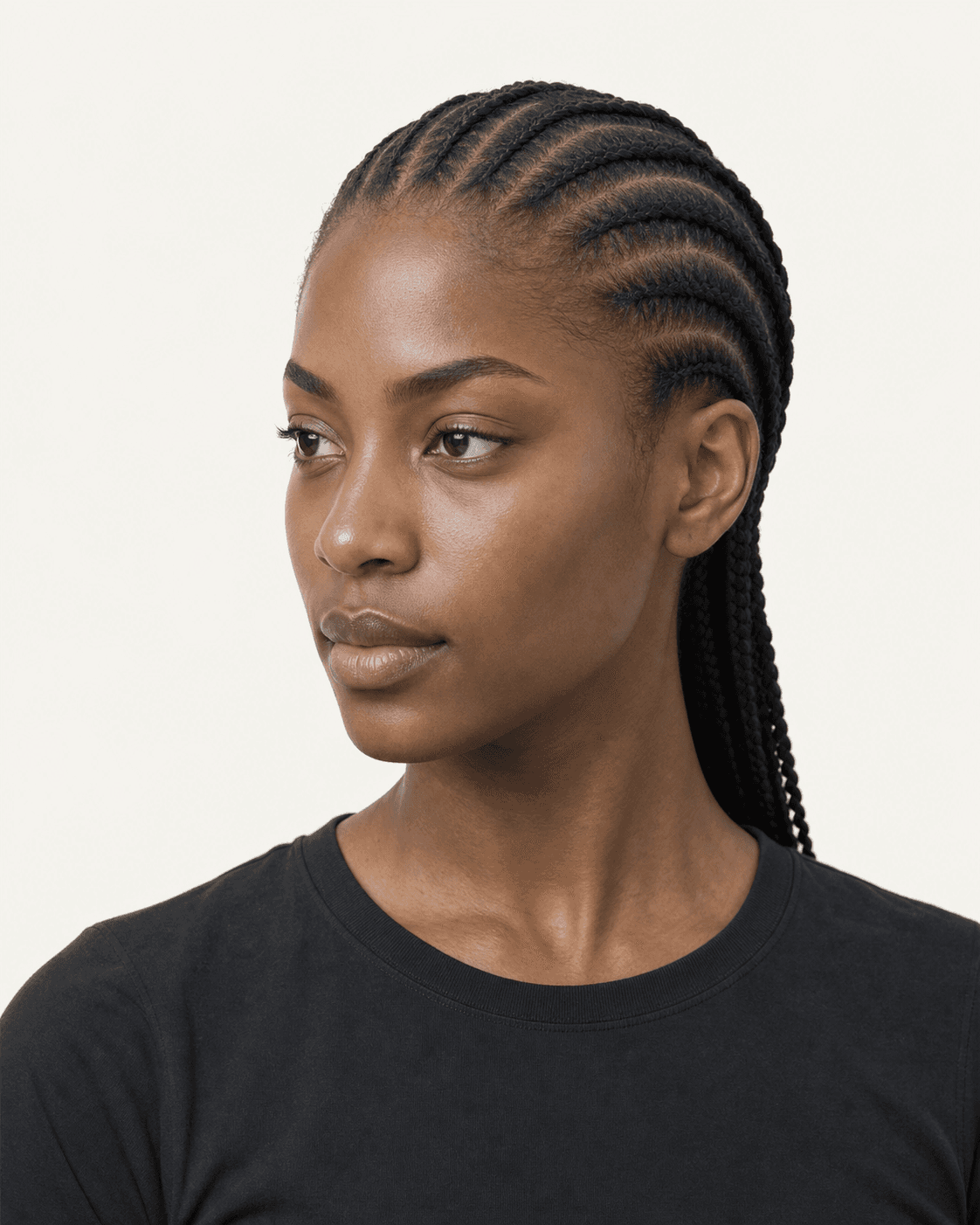
Medium straight-back feed-in cornrows with small natural starts, gradual braid growth, clean parallel sections, and long loose braid tails.

Available as a mobile service at homes, offices, and hotels across Greater Montréal.

Three-quarter view of straight-back feed-in cornrows
Interactive view4 verified angles

Three-quarter

20°

Drag to inspect the registered construction

Reference angle explorer

Drag or swipe · horizontal scroll or Shift + wheel · arrow keys

2 / 4

Fashion white · target #F2F0EA

Current documented coverage: four verified angles from 0° to 180°. A continuous 360° turntable publishes only after 24–36 consistent frames pass registry QA.

Showing three-quarter view at 20°.

Required registry views

One style. Four viewpoints.

A single portrait can hide the taper, fade height, crown, weight line, or neckline. Every published Hairqut record must show the construction from the front, three-quarter, side, and rear. The recorded fashion white backdrop keeps the silhouette readable while preserving fine strand detail.

Front view of straight-back feed-in cornrows with natural starts
Front
Three-quarter view of straight-back feed-in cornrows
Three-quarter20°
Side profile of straight-back feed-in cornrows showing parallel sections
Side90°
Rear view of straight-back feed-in cornrows continuing into long braid tails
Rear180°

Hairqut Style Blueprint · Style construction

A visual brief your professional can use.

The registered views establish the reference. This blueprint pins the most important construction decisions directly to those source views, then makes adaptation, maintenance, and the chair-side conversation clear.

Verified-angle construction map

Approved-view straight-back feed-in map

The approved front, side, and rear registry views are annotated only where the small natural starts, straight-back direction, gradual feed-in growth, parallel scalp lanes, crown-to-nape routing, and long loose braid tails are visible. The diagram does not invent a fixed row count, hidden section map, added-hair formula, insertion cadence, braid tension, or proof of continuous capture.

3 publication views · 6 callouts

Annotated front construction map for Feed-In Straight Backs. Front view of straight-back feed-in cornrows with natural starts
Front
Approved publication view

Natural starts and direction

The front view establishes the small visible starts and direct front-to-rear organization at the hairline.

01

Small natural starts

The visible rows begin with a restrained scale at the front edge rather than a bulky base

02

Straight-back direction

The exposed front sections travel rearward without decorative crossing or side patterns
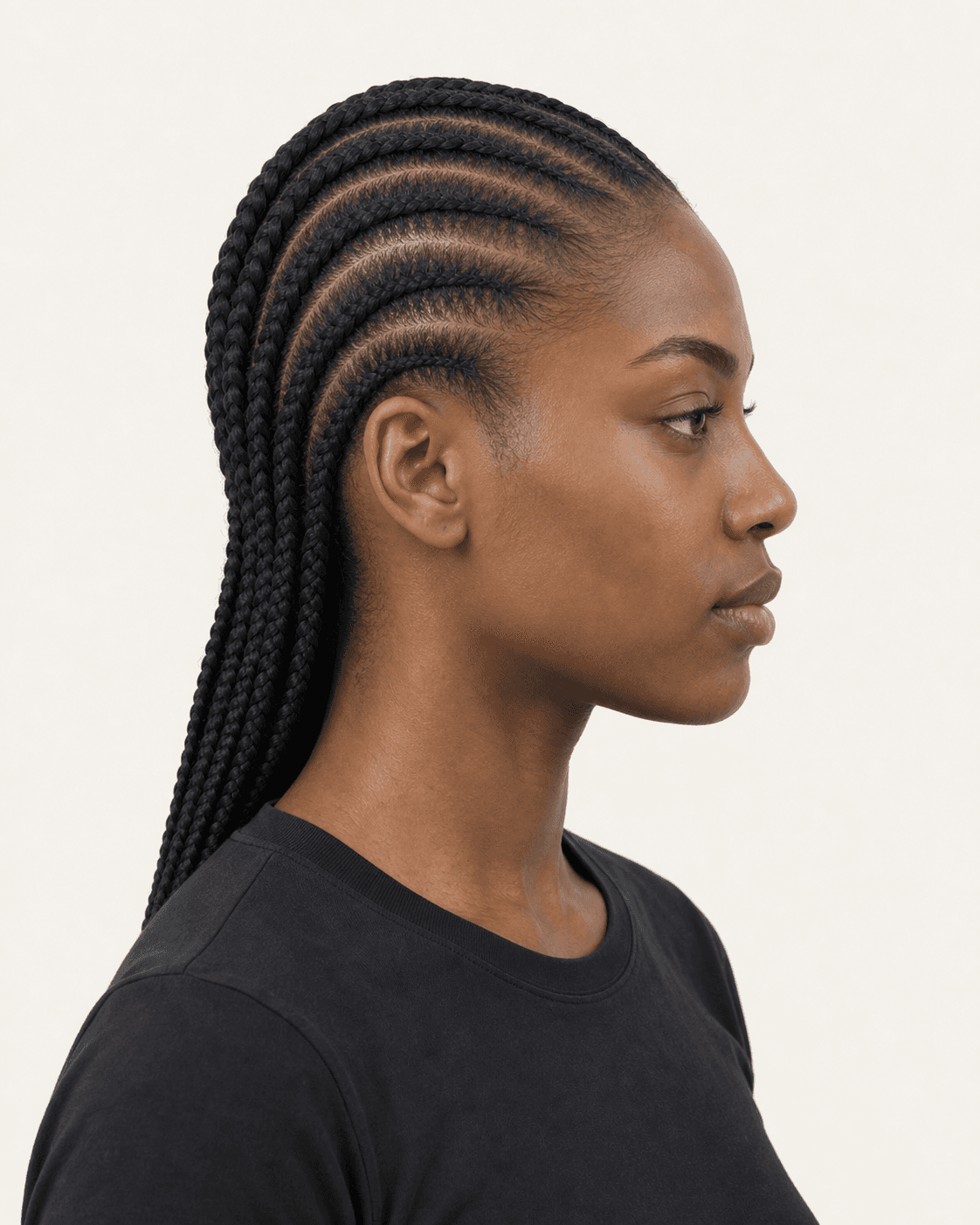
Annotated side construction map for Feed-In Straight Backs. Side profile of straight-back feed-in cornrows showing parallel sections
Side90°
Approved publication view

Feed-in growth and scalp lanes

The profile exposes gradual visible braid growth and clean parallel lanes following the skull.

01

Gradual feed-in growth

Visible braid diameter builds progressively behind the hairline; the exact addition sequence is not recorded

02

Parallel scalp lanes

Clean medium-scale sections remain broadly parallel over the visible side
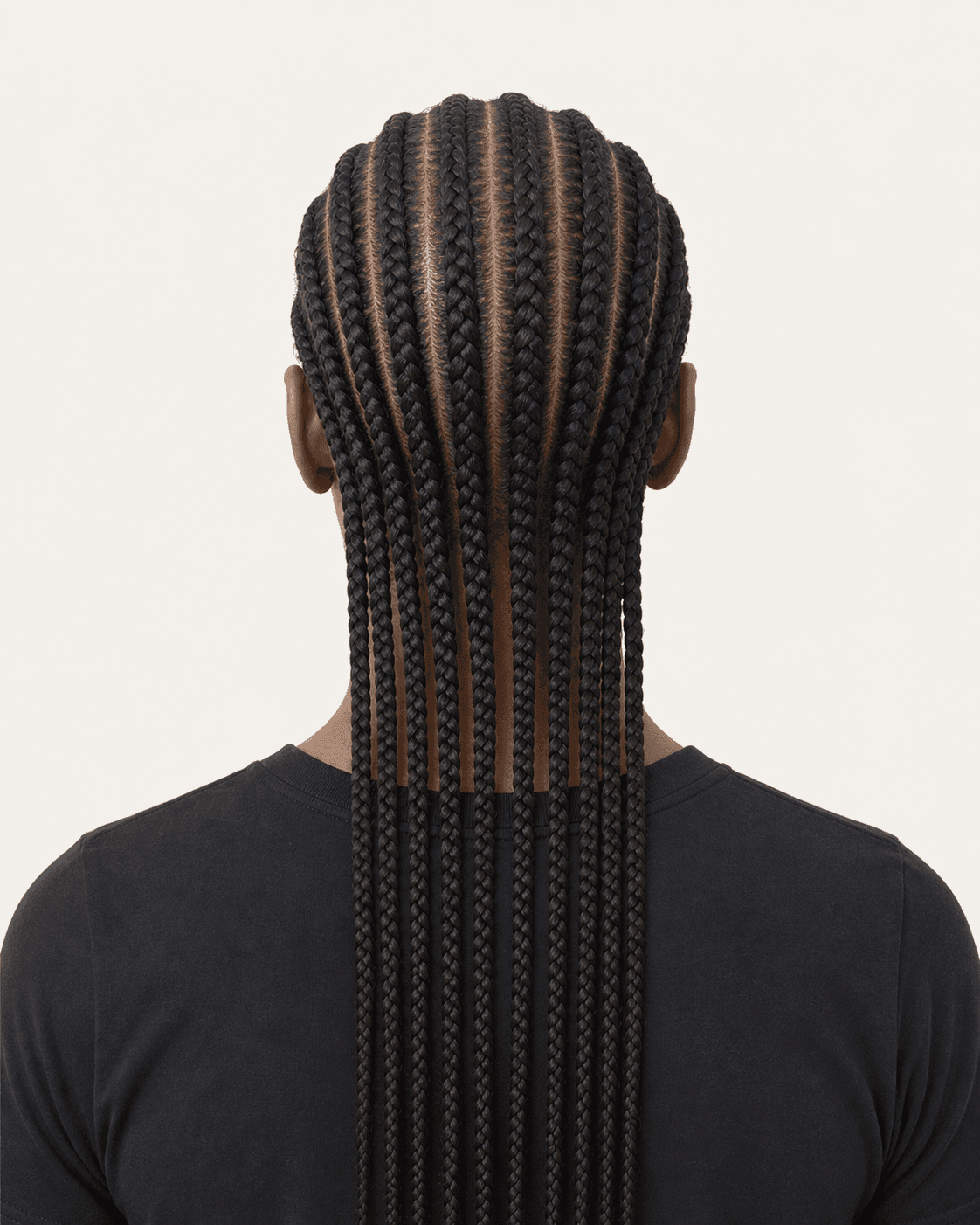
Annotated rear construction map for Feed-In Straight Backs. Rear view of straight-back feed-in cornrows continuing into long braid tails
Rear180°
Approved publication view

Rear routing and loose lengths

The rear view documents crown-to-nape routing and the transition into long free-hanging braid tails.

01

Crown-to-nape routing

Visible rows continue rearward over the crown toward the nape without a decorative route change

02

Long loose braid tails

The attached rows release below the nape into consistent free-hanging lengths

Pins locate the reference evidence; the numbered notes make the request legible in the chair. This is an original Hairqut communication diagram, not a universal service prescription.

Provenance: The diagram uses the locked approved publication views, which mirror the formal evidence package byte-for-byte. Its HTML and SVG overlays preserve those pixels and keep every label responsive and accessible. A newer generated raster was retained only as internal evaluation evidence because it recomposed the portraits and rasterized critical labels.

Reference result

Medium straight-back feed-in cornrows with small starts, parallel visible lanes, gradual braid growth, and long loose tails.

Starting-state gate

A professional must assess current length, density, fragility, hairline support, scalp condition, prior tension history, and any added-hair plan before confirming that the reference is achievable.

Visible continuity limit

Row count and spacing vary modestly across the AI-derived views. They define the medium parallel family, not one exact reproducible count or a continuous photograph of one installation.

Full specification · evidence graded

What is known, what must be assessed.

Every field is marked by its evidence boundary. “Unknown” is intentional: the registry never invents hidden technique, anatomy, timing, or price.

Construction

Technical specification

Direction
Rows travel directly from the front hairline toward the rear without curves, crossing, or decorative side patterns.
Recorded
Row scale
The registered result uses a medium visible braid scale with clean spacing.
Recorded
Hairline starts
Visible rows begin at a small, natural-looking scale along the front edge.
Visible
Feed-in progression
Visible braid diameter grows gradually behind the hairline; exact added-hair amount, insertion points, and cadence are not recorded.
Recorded
Visible sections
Clean, broadly parallel lanes follow the skull through the visible front, side, crown, and rear.
Visible
Exact row count and hidden map
The views vary modestly in visible row count and spacing; no single exact count or hidden section template is established.
Unknown
Nape transition and length
Cornrows continue toward the nape and release into long, free-hanging braid tails.
Recorded
Weight line
No haircut weight line is part of the reference; the visible outline is formed by individual braid tails.
N/A
Elevation
Haircut elevation is not applicable to this installed braid reference.
N/A
Guards, fade, taper
No clipper fade or taper is part of the canonical reference.
N/A
Neckline
The braid transition and loose tails cover the nape; no separate neckline finish is specified.
N/A
Tension and braid sequence
Exact grip, hand position, tension, extension preparation, and braiding sequence are not captured by the finished views.
Unknown

Adaptation

Hair and suitability

Reference state
A finished medium straight-back feed-in installation with long loose braid tails.
Recorded
Texture and preparation
The finished views do not establish the natural pattern, stretch method, or preparation state; select preparation after assessing the actual hair.
Assess
Density and hairline support
Assess density, strand support, thinning, breakage, and how much hair can safely support each row and any added length.
Assess
Porosity and product history
Not recorded; assess absorption, dryness, buildup, chemical or colour history, and product sensitivity before preparation and care selection.
Assess
Scalp and tension history
Assess tenderness, irritation, inflammation, bumps, lesions, traction history, and comfort before committing to the installation.
Assess
Face shape
No universal face-shape claim is supported; personalize front distribution, row scale, and visible length to the person and requested result.
Assess
Achievable starting state
Minimum length and extension suitability are not specified. Current length, fragility, density, scalp health, desired tail length, and added-hair weight determine the safe plan.
Assess
Finish dependence
Root neatness, apparent row scale, tail length, and surface frizz vary with starting hair, added-hair choice, installation method, wear, cleansing, and humidity.
Recorded

Service handoff

Booking service
womens_hairstyle
Appointment duration
Not specified in canonical evidence; confirm after hair, scalp, section count, desired length, and any added-hair plan are assessed.
Price
Not stored in this style record; the current booking service controls price and any added-hair, preparation, removal, or repair scope requires confirmation.

Professional requirements

Skills

  • Mapping balanced straight-back sections for the actual density, hairline, and skull shape
  • Building gradual feed-in diameter while avoiding a bulky front base
  • Controlling tension through the hairline, temples, crown, and nape
  • Maintaining consistent routing and finishing long loose tails according to the agreed plan

Tools and product categories

  • Parting and section-control tools selected for clean visible lanes
  • Added-hair category, if used, selected for the agreed length, weight, finish, and sensitivity history
  • Light preparation and control category chosen for the current hair and scalp without heavy buildup
  • Scalp-cleansing, thorough drying, friction-reduction, and removal categories agreed with the professional

Safety and starting state

Confirm before service

  • Current length, density, texture, fragility, shrinkage or stretch state, and chemical or colour history
  • Hairline support, breakage, thinning, scalp condition, tenderness, and prior traction response
  • Requested row scale, direction, count preference, tail length, weight, and whether added hair will be used
  • Product sensitivity, preparation needs, maintenance expectations, drying access, and removal plan

Do not promise unchanged

  • Do not install over active scalp lesions, significant inflammation, unexplained bumps, persistent tenderness, or signs that require medical assessment.
  • Do not use tight tension to force small starts or straight routing where the hairline, density, breakage, or scalp comfort cannot safely support it.
  • Do not promise the pictured row count, spacing, length, or added-hair weight from a materially different starting state; the views are not one continuous installation.
  • Do not ignore pain, headache, pulling, redness, or new bumps as a normal settling period; seek prompt adjustment.
  • Do not leave the scalp or braid bases persistently damp, layer heavy buildup between rows, or delay removal until severe matting or root stress develops.

Evidence and governance

Source package: os/hairqut-styles/registry/entries/HQ-STYLE-000044-straight-back-feed-in-cornrows

Asset relationship: All four approved publication images mirror the formal package byte-for-byte.

Generated media: The approved style views depict a fictional AI-generated subject; the underlying generation model and request ids are unavailable. The on-page diagram is a deterministic overlay on those locked views. A newer generated composite is retained only as internal evaluation evidence because it recomposed the portraits and rasterized labels.

Privacy: No real customer photo, identity, or biometric record is used in this Blueprint.

Booking handoff: The Blueprint links to the existing womens_hairstyle service; duration, price, availability, added-hair, preparation, removal, and repair scope come from the current booking and consultation flow.

Freshness

  • Asset quality and provenance package assessed 2026-08-01.
  • Blueprint geometry, internal image-generation evaluation, and full specification reviewed 2026-09-12.

Consultation

Confirm the section, extension, and comfort plan first

  • Confirm the straight-back family, medium visible scale, desired length, and whether added hair will be used.
  • Ask the professional to assess scalp condition, hairline density, breakage, traction history, current length, and the support available for each row.
  • Agree on a comfortable tension boundary before installation; pain, persistent pulling, headache, or bumps require prompt adjustment.
  • Treat the images as a construction family rather than a fixed row-count template because the approved angles do not establish one continuous installation.

Care plan

Keep the intent, not a fixed schedule.

  1. 1

    Immediately if needed

    Respond to tension or scalp change

    Pain, persistent pulling, headache, bumps, redness, or new irritation are reasons to contact the professional promptly rather than waiting for the style to loosen.

  2. 2

    While installed

    Clean gently between rows

    Use the agreed scalp-cleansing approach, avoid heavy buildup, and dry the scalp and braid bases thoroughly without rough friction.

  3. 3

    At night

    Reduce friction and tail stress

    Use a satin or silk barrier and arrange the loose lengths without tight pulling at the roots.

  4. 4

    Before matting or excess new growth

    Plan careful removal

    Remove section by section, separate added hair where present, and detangle shed hair gently rather than pulling through resistance.

Home kit

Product categories, not product pressure.

Cleanse

Light scalp-cleansing category

Choose the method with the professional for the current scalp and product history; avoid residue-heavy layering.

Dry

Thorough low-friction drying method

Dry between rows and through the braid bases before covering or tying the style.

Protect

Satin or silk night barrier

Reduce rubbing and frizz without adding root tension or trapping dampness.

Removal

Section-by-section take-down tools

Confirm the safe take-down sequence and detangling category with the professional; the registry does not prescribe a product formula.

These are care and tool categories, not paid placements or a substitute for professional scalp, hairline, and tension assessment. No brand claim, fixed wear interval, guaranteed growth result, or universal added-hair formula is present.

Professional brief

Hand this evidence-bound feed-in brief to your professional

Use the four approved registry views to align on the visible direction, row scale, gradual starts, rear routing, and loose length, then let the professional determine a safe section and extension plan from the current hair and scalp.

  • The four approved registry views and the disclosed continuity warning
  • Straight-back medium-scale rows with small visible starts
  • Gradual feed-in growth without a bulky front base
  • A comfortable tension boundary for the hairline, temples, crown, and nape
  • The desired tail length, added-hair plan, scalp care, drying, and removal plan
Book with this Blueprint

Blueprint v1.2 · reviewed . Every diagram pin and technical field was checked against the approved front, side, or rear publication view, the locked canonical record, and the formal evidence package. Exact row count, hidden section map, tension, added-hair amount, insertion cadence, braid sequence, natural texture, porosity, timing, price, and continuity across AI-derived views were left unknown or assessment-required rather than inferred.

Canonical reference data

The source record behind the Blueprint.

These are the canonical attributes of the illustrated record. The Blueprint above translates them for a consultation; this section keeps the technical source explicit.

Direction
Straight back
Row size
Medium
Start
Gradual feed-in
Finish
Long loose braid tails

Style construction

Hairline
Small natural starts preserve a soft, believable front edge.
Sections
Clean parallel lanes track straight from the front hairline through the crown.
Feed-in
Each cornrow increases gradually in diameter instead of beginning with a bulky knot.
Routing
Rows follow the skull continuously without curves, crossing, or decorative side patterns.
Lengths
The cornrows release below the nape into long, consistent braid tails.

Quality assessment

Visible, not implied.

92/ 100

Publication threshold: 85. Assessed .

Identity consistency91
Haircut geometry91
View compliance100
Hair realism92
Anatomy realism94
Photography consistency93
Provenance completeness95
Why this record passed with warnings
  • Visible row count and spacing vary modestly across derived viewpoints; all views preserve medium parallel straight-back feed-in construction and long braid tails.
  • OpenAI built-in image generation was used; the underlying model identifier is not exposed by this surface.
  • AI-derived viewpoints are internally consistent illustrations, not proof that one physical subject was photographed continuously from four angles.

Registry provenance

100% AI-generated from scratch.

The four images are an intentionally matched fictional reference set made specifically for this Hairqut record. Fictional person; no real person or celebrity was used as a reference. The set passed deterministic asset checks and a separate visual consistency assessment.

Generated media record: OpenAI built-in image generation via ChatGPT. underlying model identifier not exposed.

Book your appointment