
Verified-angle construction map
Approved-view opening, wave-direction, and lower-edge map
The approved front, side, and rear views are annotated only where the near-central opening, cheek-to-jaw face-side bends, separated side wave bands, shoulder-skimming lower edge, continuous rear wave lanes, and softly uneven rear perimeter are visible. Natural texture, exact length, hidden layers, sectioning, elevation, tools, product, heat, timing, and price are not prescribed.
3 publication views · 6 callouts

Near-central opening and cheek-to-jaw wave onset
The front documents visible opening and face-side movement without assigning a permanent natural part, exact layer origin, symmetry, or cutting geometry.
- 01
Near-central opening
A visible near-central opening divides the front field; natural persistence, source section, symmetry, and styling method are unknown
- 02
Cheek-to-jaw wave onset
Visible face-side bends begin around cheek-to-jaw level and travel away from the face; shortest dry point, hidden layer origin, and connection are unrecorded

Separated side wave bands and shoulder-skimming lower edge
The profile distinguishes finished surface bends from the lower dry edge without claiming a natural wave class, hidden layer map, or prescribed styling technique.
- 01
Separated side wave bands
Several visible S-shaped surface bands alternate through the side; natural pattern, hidden layers, graduation, connection, and weight removal are not proven
- 02
Shoulder-skimming lower edge
The finished lower ends meet or hover near the shoulder in the cropped view; exact body-landmark length, shrinkage, tension, and cutting line are unknown
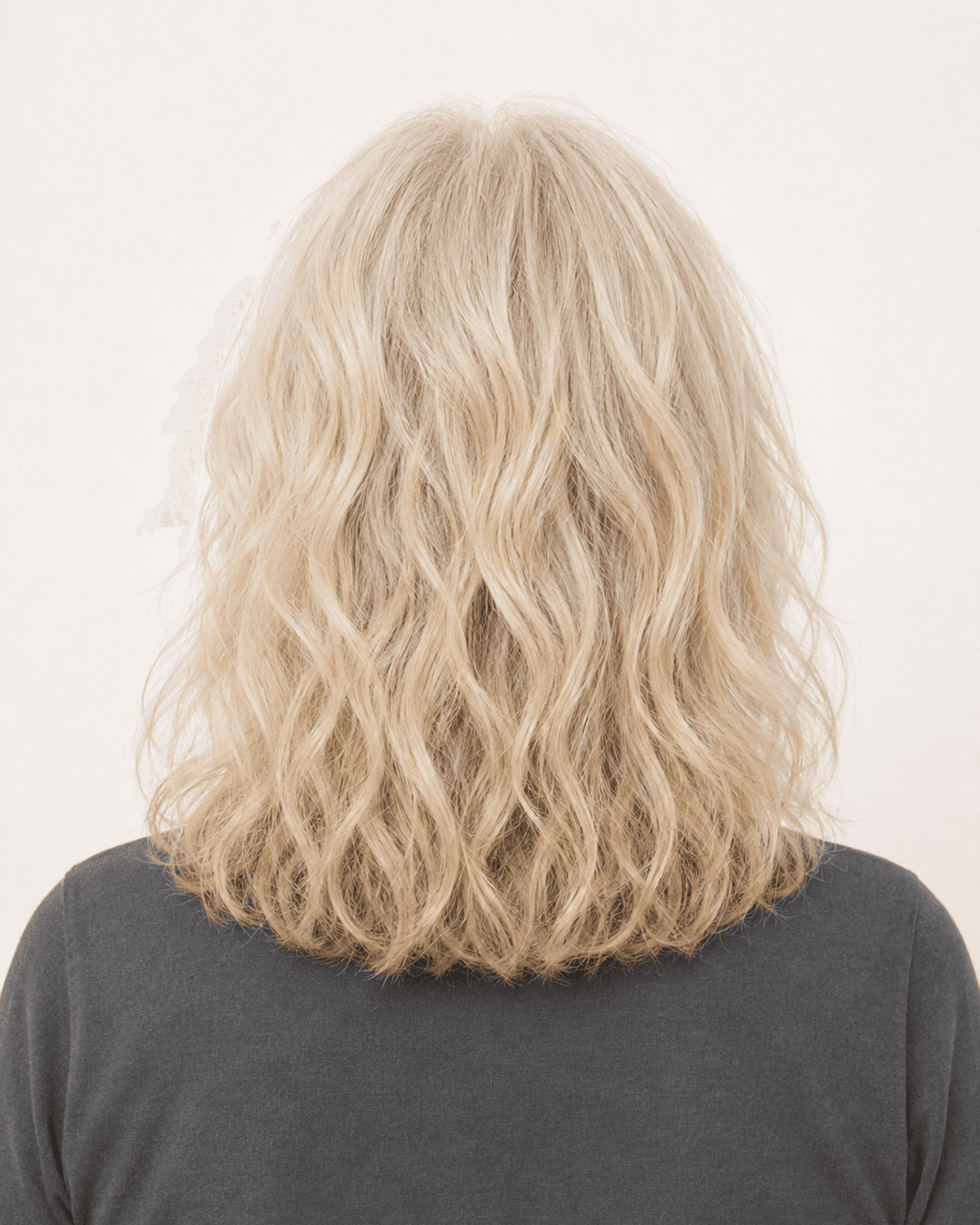
Continuous rear wave lanes and softly uneven rear perimeter
The rear records visible wave paths and lower edge variation without inventing part continuation, symmetry, hidden layers, internal density, or cutting line.
- 01
Continuous rear wave lanes
Visible wave lanes descend from retained crown coverage toward the ends; natural pattern, hidden layer count, sectioning, elevation, and internal density are unknown
- 02
Softly uneven rear perimeter
The lower rear edge is soft and irregular around shoulder level rather than a crisp straight line; exact baseline, symmetry, tension, and finish method are unrecorded
Pins locate the reference evidence; the numbered notes make the request legible in the chair. This is an original Hairqut communication diagram, not a universal service prescription.
Provenance: The diagram uses locked publication views that mirror the formal package byte-for-byte. Semantic HTML and SVG overlays preserve approved pixels and accessible text; no replacement raster was generated. Conversation-level source: conv:6a5d8bcd-7ab4-83ea-9138-17f07d60a5a0.