
Verified-angle cut map
Approved-view broken fringe, side transition, and rear-weight map
The approved front, side, and rear views are annotated only where broken fringe points, forehead-skimming fall, a long-over-short side transition, close ear contour, crown convergence, and a soft low nape edge are visible. The diagram does not prescribe exact lengths, eye-clearance target, natural texture, hidden layers, connection, elevation, cutting sequence, taper class, guards, tools, products, timing, or price.
3 publication views · 6 callouts

Broken fringe points and forehead-skimming fall
The front records visible fringe placement without assigning exact length, dry clearance, natural texture, cutting tool, or product.
- 01
Broken fringe points
Separated irregular points form a soft non-blunt visible edge; exact sectioning, cutting angle, texturizing method, and strand-by-strand continuity are unknown
- 02
Forehead-skimming fall
The lowest visible pieces approach the eyebrow zone; intended dry eye and forehead clearance must be confirmed from the child’s actual fall and comfort

Long-over-short side transition and close ear contour
The profile distinguishes the visible upper/lower contrast from unsupported taper, guard, connection, or tool claims.
- 01
Long-over-short side transition
A fuller upper field overlaps a much shorter lower side; exact connection, weight removal, blend zone, guards, and cutting sequence are unrecorded
- 02
Close ear contour
The lower side follows closely above and behind the visible ear; exact perimeter method, skin exposure, and symmetry are unknown
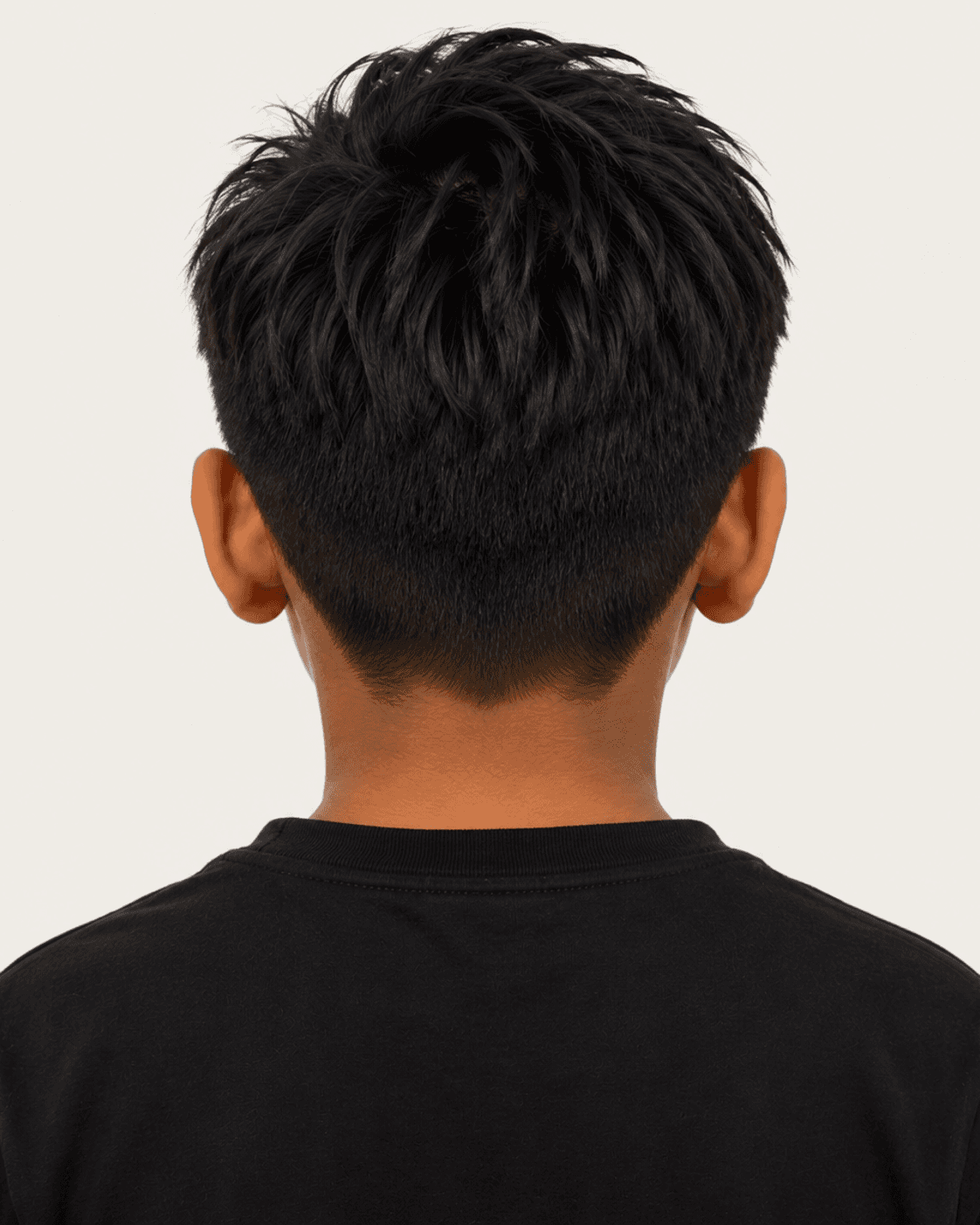
Crown convergence and soft low nape edge
The rear documents upper-rear direction and lower-rear resolution without inventing a crown section, taper class, neckline, or one continuous subject.
- 01
Crown convergence
Visible surface channels converge around the upper rear crown area; exact whorl map, sections, elevation, direction, and weight distribution are unknown
- 02
Soft low nape edge
The shorter lower rear resolves into a soft low edge; exact taper class, guard, skin exposure, edge tool, and neckline intent are unrecorded
Pins locate the reference evidence; the numbered notes make the request legible in the chair. This is an original Hairqut communication diagram, not a universal service prescription.
Provenance: The diagram uses locked canonical messy-fringe publication views that mirror the formal package byte-for-byte. Semantic HTML and SVG overlays preserve approved pixels, child-safe presentation, and accessibility.