
Verified-angle construction map
Approved-view low close-fade construction map
The approved front, side, and rear views are annotated only where the short textured top, straight defined front edge, low temple-to-ear gradient, connected upper side, retained rear mass, and soft low nape resolution are visible. The diagram does not prescribe curl code, density, exact length, skin exposure, guards, measured fade height, blend distance, edge tool, enhancement, or product formula.
3 publication views · 6 callouts

Short textured top and straight defined front edge
The front establishes compact visible coil texture above a straight, defined-looking boundary.
- 01
Short textured top
The visible top stays compact with tight coiled surface texture; exact centimetres, curl code, density, elevation, and product state are not recorded
- 02
Straight defined front edge
The front boundary reads broadly straight and crisp, but natural edge position, pushback history, tool pressure, and enhancement use are unknown

Low temple-to-ear gradient and connected upper side
The profile confines the closest visible gradient to the lower temple and ear area beneath a darker connected upper side.
- 01
Low temple-to-ear gradient
The strongest light-to-dark transition follows the lower temple and ear contour; true skin exposure, measured ceiling, guards, and blend sequence are not proven
- 02
Connected upper side
A darker band remains connected between the textured top and the lower gradient without a visible undercut or high exposed fade
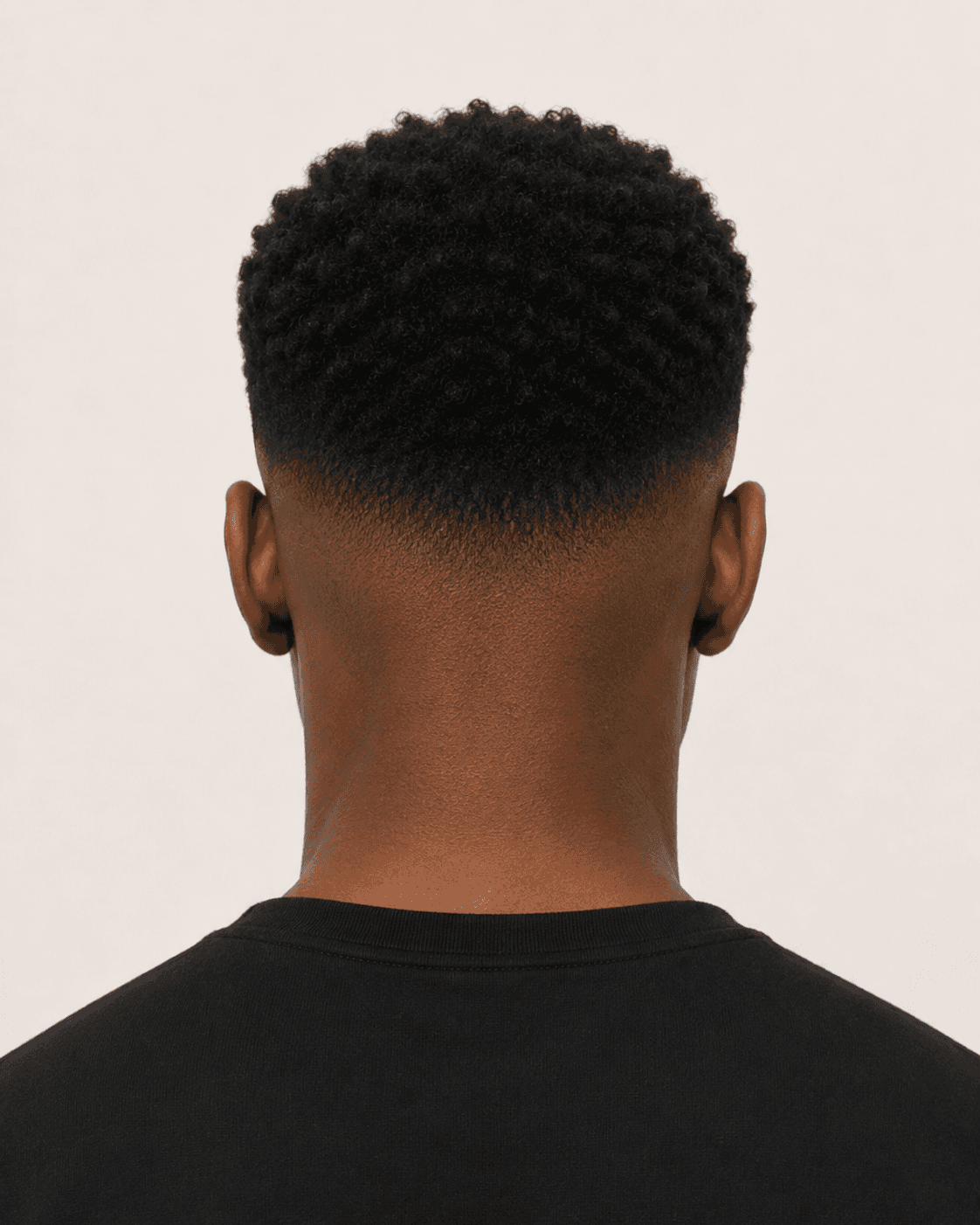
Retained rear mass and soft low nape resolution
The rear keeps crown and occipital density above a symmetric low wraparound transition that softens at the nape.
- 01
Retained rear mass
The crown and upper occipital field remain dark and connected above the low transition; measured density and hidden weight distribution are not established
- 02
Soft low nape resolution
The shortest visible rear transition resolves low and softly without a blocked horizontal neckline; exact zero-length and finishing method are unknown
Pins locate the reference evidence; the numbered notes make the request legible in the chair. This is an original Hairqut communication diagram, not a universal service prescription.
Provenance: The diagram uses locked approved publication views that mirror the reconciled formal package byte-for-byte. Semantic HTML and SVG overlays preserve those pixels; any generated raster evaluation remains internal unless it meets the same provenance and accessibility gates.