
Verified-angle construction map
Approved-view curly high-top construction map
The approved front, side, and rear registry views are annotated only where the defined front edge, rounded coil volume, darker transition band, close side fade, symmetric rear fade, and low nape transition are visible. The diagram does not prescribe curl-type codes, guards, measured fade height, hidden sectioning, top elevation, cutting sequence, product formula, or maintenance timing.
3 publication views · 6 callouts

Defined front edge and rounded coil volume
The front view establishes a clean natural-looking edge beneath a dense, softly rounded top rather than a flat geometric platform.
- 01
Defined front edge
The front edge is clean and even-looking without a pushed-back corner claim, painted enhancement, hard part, or carved design line
- 02
Rounded coil volume
Dense tightly coiled volume forms a softly rounded high-top silhouette; exact curl type, length, elevation, and shaping method are not established

Darker transition band and close side fade
The profile shows retained darkness beneath the curl mass stepping into a close fade around the temple and ear.
- 01
Darker transition band
A visibly denser band remains below the top before the fade lightens; it is not evidence of a disconnected shelf or fixed blend recipe
- 02
Close side fade
The side shortens closely around the temple and ear, but pixels do not prove a zero setting, exposed skin throughout, exact fade height, or guard sequence
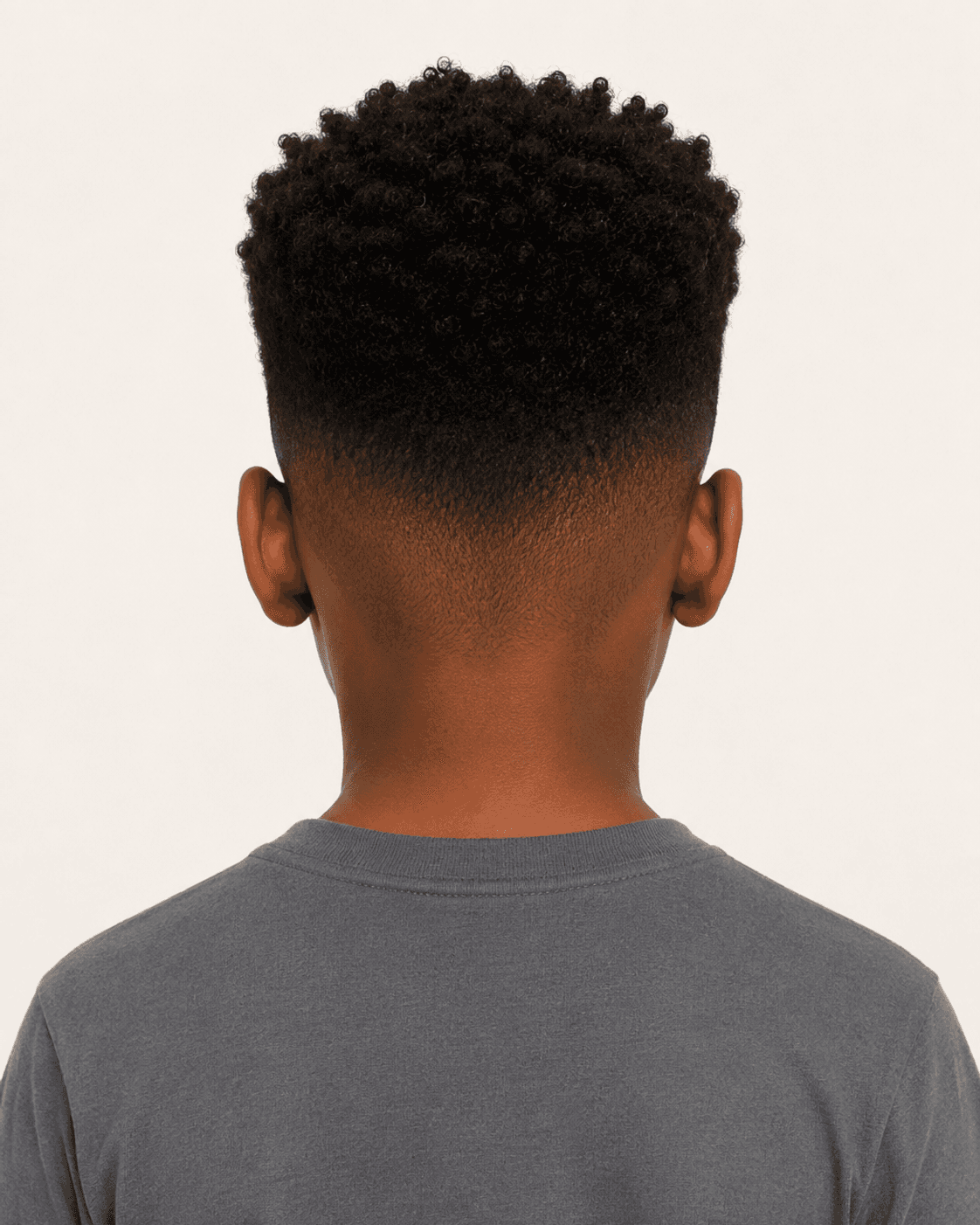
Symmetric rear fade and low nape transition
The rear view records dense crown volume tapering symmetrically through a close gradient to a low, clean nape.
- 01
Symmetric rear fade
The rear gradient appears balanced from left to right beneath the dense crown without a carved V, burst arc, or high disconnected panel
- 02
Low nape transition
The shortest visible rear zone finishes low at the nape with a soft natural-looking edge rather than a boxed or pointed neckline
Pins locate the reference evidence; the numbered notes make the request legible in the chair. This is an original Hairqut communication diagram, not a universal service prescription.
Provenance: The diagram uses the locked approved publication views, which mirror the reconciled formal package byte-for-byte. Its HTML and SVG overlays preserve those pixels and keep every label responsive and accessible. A newer generated raster passed all six exact labels and child-presentation boundaries but remains internal because its output cannot prove approved-pixel preservation and critical labels would not remain semantic.