
Hairqut.
HQ-STYLE-000028QA passed with warnings

Haircut · Curly

Curly Fringe Crop

A rounded curly crop with separated ringlets falling over the forehead, fuller upper volume, shorter temple and side fields, a dense rear curl field, and a low natural nape edge.

Available as a mobile service at homes, offices, and hotels across Greater Montréal.

Three-quarter view of a curly fringe crop showing rounded curl volume and a shorter side field
Interactive view4 verified angles

Three-quarter

20°

Drag to inspect the registered construction

Reference angle explorer

Drag or swipe · horizontal scroll or Shift + wheel · arrow keys

2 / 4

Fashion white · target #F2F0EA

Current documented coverage: four verified angles from 0° to 180°. A continuous 360° turntable publishes only after 24–36 consistent frames pass registry QA.

Showing three-quarter view at 20°.

Required registry views

One cut. Four viewpoints.

A single portrait can hide the taper, fade height, crown, weight line, or neckline. Every published Hairqut record must show the construction from the front, three-quarter, side, and rear. The recorded fashion white backdrop keeps the silhouette readable while preserving fine strand detail.

Front view of a curly fringe crop with separated forehead ringlets
Front
Three-quarter view of a curly fringe crop showing rounded curl volume and a shorter side field
Three-quarter20°
Side profile of a curly fringe crop showing forward fringe projection and a shorter temple field
Side90°
Rear view of a curly fringe crop showing a dense curl field and low natural nape edge
Rear180°

Hairqut Style Blueprint · Cut geometry

A visual brief your professional can use.

The registered views establish the reference. This blueprint pins the most important construction decisions directly to those source views, then makes adaptation, maintenance, and the chair-side conversation clear.

Verified-angle cut map

Approved-view curly fringe and crop transition map

The approved front, side, and rear views are annotated only where the separated fringe ringlets, rounded upper volume, forward fringe projection, shorter temple field, dense rear curl field, and low natural nape edge are visible. The diagram does not prescribe curl type, exact length, shrinkage, hidden sections, elevation, taper class, guards, shear method, products, timing, or price.

3 publication views · 6 callouts

Annotated front construction map for Curly Fringe Crop. Front view of a curly fringe crop with separated forehead ringlets
Front
Approved publication view

Separated fringe ringlets and rounded upper volume

The front records fringe placement and rounded volume without assigning a natural curl code, dry length, density, or cutting method.

01

Separated curl fringe

Defined ringlets fall in separated groupings across the upper forehead; natural pattern, dry length, shrinkage, eye clearance, and set method require assessment

02

Rounded upper volume

The upper field forms a full rounded arc with dense-looking curl definition; internal layers, elevation, density, and product contribution are unknown
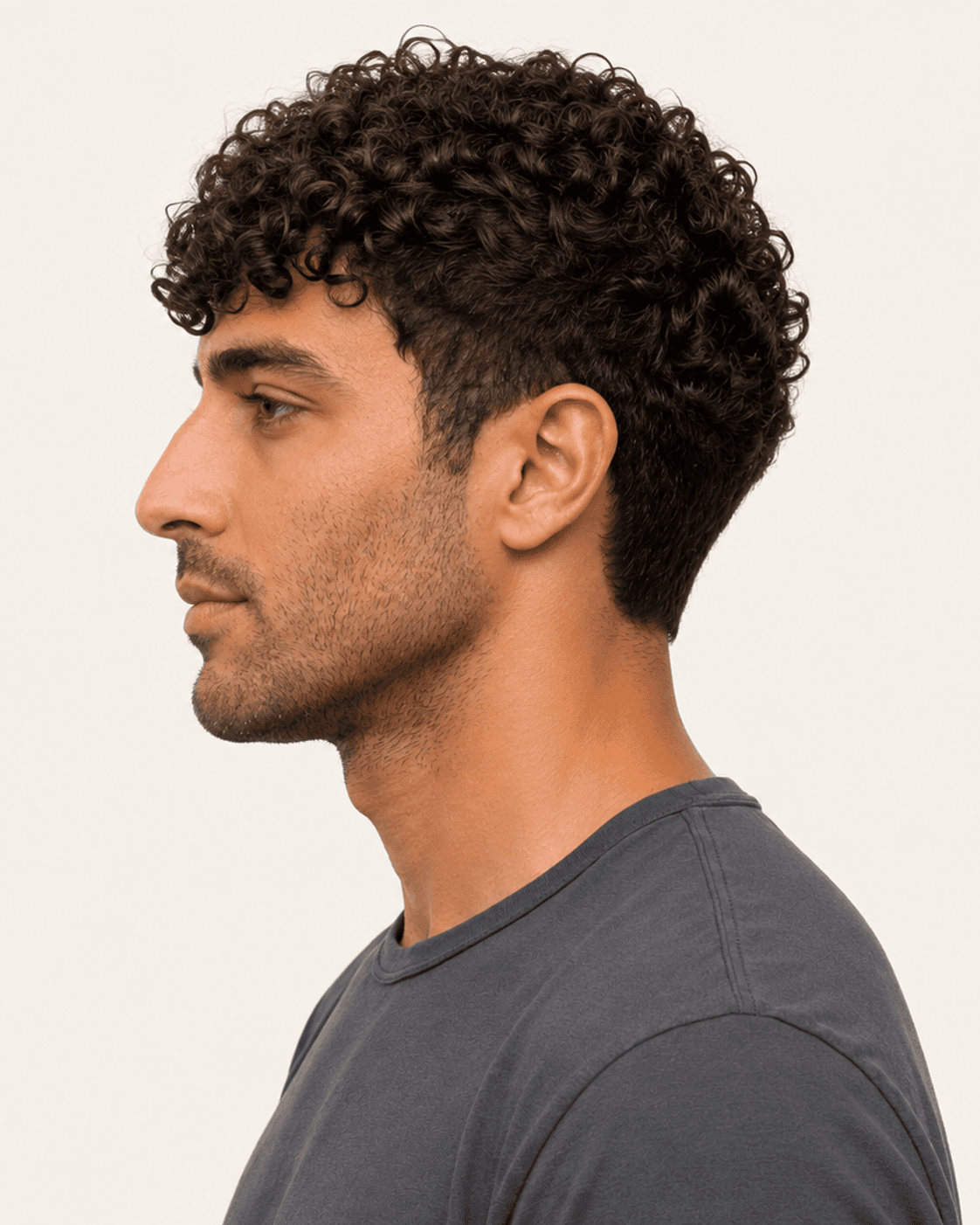
Annotated side construction map for Curly Fringe Crop. Side profile of a curly fringe crop showing forward fringe projection and a shorter temple field
Side90°
Approved publication view

Forward fringe projection and shorter temple field

The profile separates the projected front curls and rounded upper field from the shorter temple and side without naming a measured taper.

01

Forward fringe projection

Front curl groupings project forward from the upper field; hidden overdirection, cutting angle, dry response, and styling method are unrecorded

02

Shorter temple field

The temple and side read shorter than the upper curls with a soft transition; taper height, guards, lever positions, blend sequence, and skin exposure are unknown
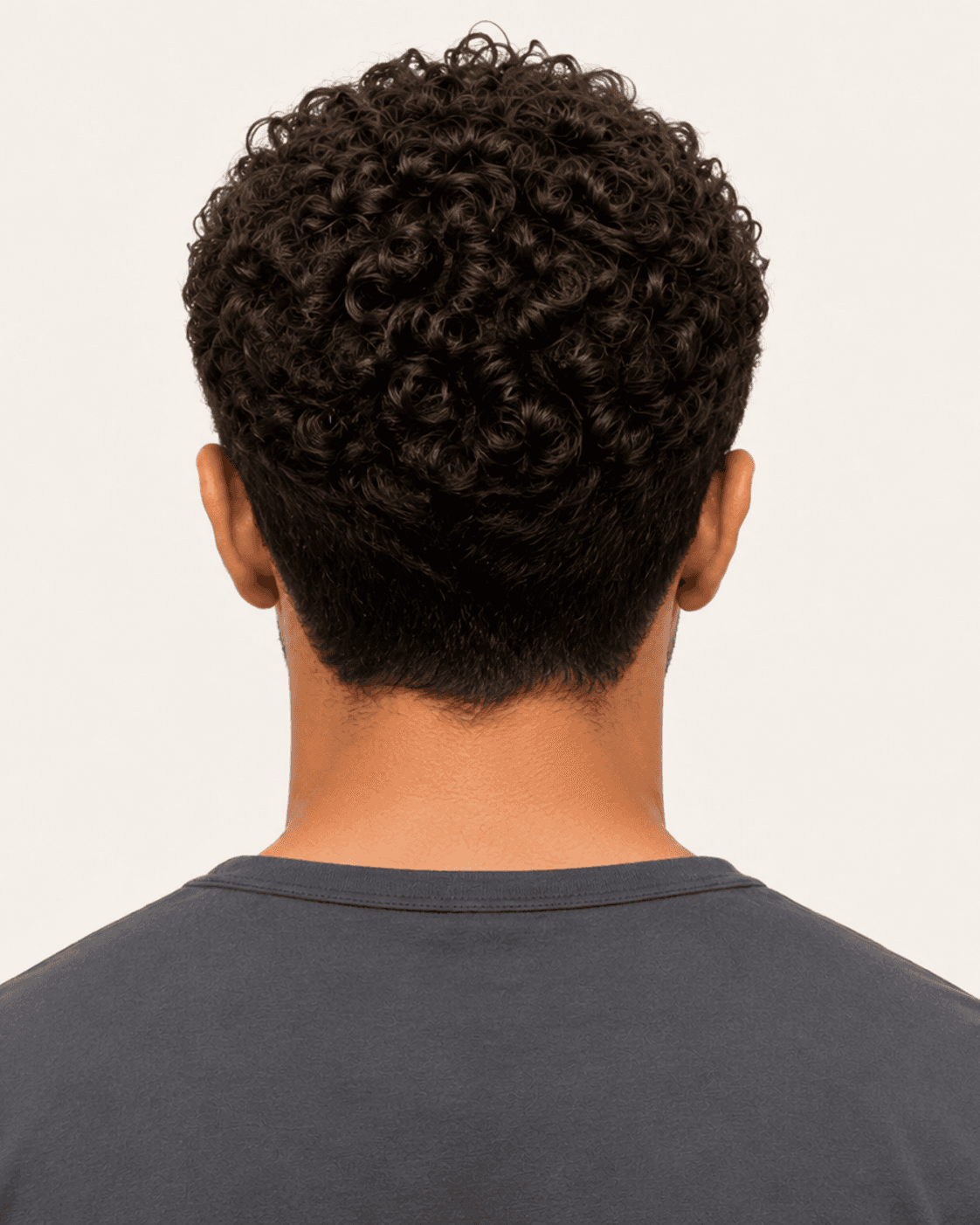
Annotated rear construction map for Curly Fringe Crop. Rear view of a curly fringe crop showing a dense curl field and low natural nape edge
Rear180°
Approved publication view

Dense rear curl field and low natural nape edge

The rear records visible curl mass and the lower transition without inventing a crown map or nape technique.

01

Dense rear curl field

Defined curls form a rounded rear field above the lower band; natural density, hidden crown direction, sectioning, elevation, and curl-by-curl method are unknown

02

Low natural nape edge

A shorter lower rear band resolves into a softly rounded low edge; tools, taper class, guards, and edge method are unrecorded

Pins locate the reference evidence; the numbered notes make the request legible in the chair. This is an original Hairqut communication diagram, not a universal service prescription.

Provenance: The diagram uses locked canonical curly-fringe-crop publication views that mirror the formal package byte-for-byte. Semantic HTML and SVG overlays preserve approved pixels and accessibility.

Reference result

A rounded curly crop with separated forward fringe ringlets, fuller upper volume, shorter temple and side fields, a dense rear curl field, and a low natural nape edge.

Starting-state gate

A professional must assess natural pattern and shrinkage, density by zone, strand support, current length, prior layers or taper, hairline, crown and nape growth, scalp, condition, porosity, tangling, routine, vision clearance, comfort, and budget before confirming the result.

Adaptation boundary

Fringe length and fall, upper volume, curl grouping, side contrast, rear weight, nape edge, and finish must be adapted. A curl label, face shape, or density alone does not determine suitability.

Full specification · evidence graded

What is known, what must be assessed.

Every field is marked by its evidence boundary. “Unknown” is intentional: the registry never invents hidden technique, anatomy, timing, or price.

Construction

Technical specification

Canonical taxonomy
Haircut in the Curly family, canonically named Curly Fringe Crop; the name records a visible curly crop and forward fringe, not a verified natural curl code or universal construction.
Recorded
Fringe placement
Separated curl groupings fall forward across the upper forehead with varied visible lengths.
Visible
Upper silhouette
A full rounded curl field extends from the front through the crown area.
Visible
Temple and side
The temple and side field is visibly shorter than the upper curls with a soft transition and exposed ear contour.
Visible
Rear and nape
A dense rounded rear curl field continues above a shorter lower band and softly rounded low nape edge.
Visible
Length and shrinkage
Exact wet and dry lengths, fringe drop, shrinkage percentage, and transferable measurements are not documented.
Unknown
Cutting construction
Sectioning, elevation, overdirection, cutting angle, tension, curl-by-curl versus grouped method, shear type, texturizing, clipper work, guards, taper height, and refinement sequence are not documented.
Unknown
Finish method
Water, leave-in, cream, gel, mousse, oil, brush styling, finger coiling, diffusing, air drying, heat, and product amounts are not documented.
Unknown
Facial-hair boundary
No facial-hair construction is defined by this style record or included through the haircut mapping.
N/A

Adaptation

Hair and suitability

Visible reference finish
The views show defined ringlets, rounded volume, forward fringe, shorter sides, and a dense rear field, not verified natural curl type, density, porosity, or unstyled behavior.
Visible
Pattern and shrinkage
Assess natural pattern by zone, wet-to-dry change, spring, shrinkage, reversion, frizz, grouping, and daily fall; the finished pixels do not establish 3A, 3B, or another code.
Assess
Density and strand support
Assess density by zone, strand diameter, scalp visibility, thinning, bulk, and support for fringe separation, rounded volume, and the rear field.
Assess
Growth behavior
Assess hairline, temple direction, cowlicks, crown rotation, nape growth, asymmetry, and daily fall before confirming fringe, side, rear, and nape placement.
Assess
Current length and construction
Assess wet and dry length by zone, existing layers, taper height, disconnection, home cutting, uneven growth, transition bands, and correction needs.
Assess
Condition, porosity, and tangling
Assess absorption, dryness, elasticity, breakage, knots, matting, shedding, chemical and colour history, friction, buildup, and environmental exposure.
Assess
Scalp and edge comfort
Assess irritation, lesions, flaking, tenderness, bumps, thinning, scars, ingredient sensitivity, close-tool tolerance, and hygiene.
Assess
Face, head, and vision
No universal suitability rule is supported. Personalize fringe clearance, width, upper volume, side contrast, rear weight, and nape edge to anatomy, vision, growth, support, preference, and comfort.
Assess
Routine and environment
Confirm washing, detangling, drying, sleep friction, headwear, climate, humidity, activity, product feel, visits, mobility, time, and budget.
Assess
Continuous-view limitation
The four AI-derived views are consistent illustrations but do not prove one continuous physical subject, identical curl placement, or a hidden one-to-one construction map.
Unknown

Service handoff

Booking service
mens_haircut_style
Appointment duration
Not specified in canonical evidence; confirm after wet and dry length, pattern, shrinkage, density, existing construction, detangling needs, scalp, fringe clearance, finish, accessibility, and separately scoped additions are assessed.
Price
Not stored in this style record; the current booking service controls haircut price, while facial-hair work, specialist scalp service, colour, treatment, correction, and extensive curl styling require separate confirmation.

Professional requirements

Skills

  • Balancing dry fringe clearance, rounded upper volume, side contrast, rear curl mass, and a low natural nape edge from the current wet and dry starting state
  • Reading pattern and shrinkage by zone, density, strand support, hairline, crown and nape growth, condition, porosity, tangling, scalp, and prior construction
  • Choosing sectioning, elevation, overdirection, tension, curl grouping, cutting tools, side and rear transition, drying, and finishing without relying on an inferred pixel recipe
  • Managing detangling, close-tool hygiene, heat, pressure, scalp comfort, eye clearance, product sensitivity, and aftercare with informed consent

Tools and product categories

  • Shears, combs, clips, clippers, guards, trimmers, and detail tools selected from the assessed construction rather than a fixed recipe
  • Fingers, comb, or brush category selected for actual pattern, tangling, wetness, slip, direction, breakage risk, scalp comfort, and hygiene
  • Cleansing, conditioning, detangling, moisture, definition, hold, heat-protection, and finishing categories selected for porosity, condition, scalp, ingredients, buildup, climate, and washability
  • Diffuser, dryer, towel, or air-dry method selected for shrinkage, frizz, condition, heat tolerance, time, accessibility, and desired finish

Safety and starting state

Confirm before service

  • Current wet and dry fringe, top, temple, side, crown, rear, and nape lengths plus existing layers, taper, disconnection, home cutting, uneven growth, or transition bands
  • Natural pattern and shrinkage by zone, density, strand diameter, scalp visibility, hairline, crown and nape direction, asymmetry, and daily fall
  • Condition, porosity, elasticity, knots, matting, shedding, breakage, irritation, lesions, scars, tenderness, chemical and colour history, friction, and buildup
  • Desired fringe clearance, upper volume, curl grouping, side contrast, rear weight, nape edge, finish, facial-hair boundary, maintenance, access, time, and budget

Do not promise unchanged

  • Do not promise 3A–3B suitability, universal density compatibility, exact dry length, shrinkage, one continuous subject, or a fixed result from the finished images.
  • Do not cut the fringe from wet appearance alone or compromise eye clearance before confirming dry fall, spring, shrinkage, forehead comfort, routine, and consent.
  • Do not prescribe texturizing shears, curl-by-curl cutting, guards, taper height, heat, diffusing, brush styling, curl cream, or a fixed sequence without assessment and consent.
  • Do not detangle or cut through severe matting, active breakage, unexplained shedding, scalp pain, or compromised hair without adapting scope and referring out when appropriate.
  • Do not imply that mens_haircut_style includes facial-hair work, specialist scalp service, colour, treatment, correction, or extensive curl styling; confirm scope, qualification, time, price, and aftercare separately.
  • Pause or adapt for active irritation, open lesions, infection concern, persistent bumps, significant breakage, unexpected shedding, chemical injury, or scalp integrity that cannot safely support the plan.

Evidence and governance

Source package: os/hairqut-styles/registry/entries/HQ-STYLE-000028-curly-fringe-crop

Asset relationship: All four canonical curly-fringe-crop publication images mirror the formal package byte-for-byte.

Generated media: The approved style views depict a fictional AI-generated adult. gpt-image-2 was requested through ChatGPT under conversation identifier conv:6a60eda7-5c44-83ea-8cea-8160dbe6bc2a, but the exact responding model and API request ids were not independently confirmed. The on-page diagram is a deterministic overlay on the locked views.

Privacy: No real customer photo, identity, scalp record, health record, or biometric record is used in this Blueprint.

Booking handoff: The Blueprint links to the existing mens_haircut_style service; duration, price, availability, accessibility needs, and separately scoped facial-hair work, scalp service, colour, treatment, correction, or extensive styling come from booking and consultation.

Freshness

  • Asset quality and source-record provenance assessed 2026-07-22 and formally reconciled 2026-09-12.
  • Blueprint geometry, service boundary, and full specification reviewed 2026-09-12.

Consultation

Confirm fringe clearance, upper volume, side contrast, rear weight, and nape edge

  • Align on the separated fringe ringlets, rounded upper volume, shorter side field, dense rear curl field, and low nape edge using all four approved views.
  • Assess current wet and dry length, natural pattern and shrinkage, density by zone, strand diameter, hairline, crown and nape growth, scalp, condition, porosity, tangling, prior layers or taper, and routine.
  • Confirm whether the current hair can achieve the reference now or requires altered fringe length, less or more upper volume, softer side contrast, a different rear connection, or a longer nape.
  • Separate the haircut from facial-hair work, specialist scalp service, colour, treatment, extensive curl styling, and any additional service, including qualification, sensitivity, time, price, consent, and aftercare.

Care plan

Keep the intent, not a fixed schedule.

  1. 1

    When the fringe changes vision or forehead comfort

    Reassess dry fall and clearance

    Growth, shrinkage, curl grouping, humidity, activity, preference, and eye or forehead comfort determine whether to trim, redirect, or adapt.

  2. 2

    When upper volume or side contrast loses balance

    Review the crop as one silhouette

    Check current length, curl spring, density support, crown behavior, prior taper, rear weight, and desired contrast before repeating a fixed recipe.

  3. 3

    After cleansing, sleep, activity, or weather change

    Use the lowest-stress workable curl reset

    Cleansing, conditioning, detangling, drying, moisture, and control depend on scalp, porosity, buildup, shrinkage, climate, activity, and wash access.

  4. 4

    When scalp, edge, or curl integrity changes

    Pause and reassess

    Do not repeat cutting, tension, brushing, heat, or close-tool work through persistent irritation, lesions, burning, tenderness, matting, unexpected shedding, or breakage.

Home kit

Product categories, not product pressure.

Cleanse

Scalp- and buildup-appropriate cleansing category

Choose strength and frequency for oil, sensitivity, activity, product load, water exposure, tangling, and wash access.

Condition

Slip and moisture category

Select for porosity, strand support, dryness, tangling, ingredients, residue, rinse preference, and scalp response.

Detangle

Finger, comb, or brush category suited to the assessed curls

Choose section size, wetness, slip, direction, pressure, and frequency for actual pattern, shedding, breakage risk, scalp comfort, and hygiene.

Define

Light moisture, definition, or hold category when wanted

Choose only after checking porosity, shrinkage, movement, touch, buildup, climate, reworkability, and washability.

Dry and protect

Low-stress drying and friction-control category

Adapt air, towel, diffuser, heat, headwear, and sleep friction to condition, scalp, shrinkage, time, climate, and accessibility.

This Blueprint documents fictional AI-generated adult reference views. It is consultation support, not proof of natural curl type, density, porosity, exact wet or dry length, shrinkage, identical anatomy or continuity, hidden sectioning, elevation, taper class, guards, shear method, product system, timing, price, or guaranteed result.

Professional brief

Hand this evidence-bound curly fringe crop brief to your professional

Use the canonical four approved views to align on fringe fall, rounded upper volume, side contrast, rear curl field, and nape edge, then choose construction from the current hair and scalp.

  • The four approved views and the warning that they are AI-derived illustrations rather than one continuous physical capture
  • Separated forward fringe ringlets with dry clearance agreed after assessing natural pattern, shrinkage, spring, and daily fall
  • Rounded upper volume and a shorter temple field without assuming curl code, density, hidden layers, elevation, taper height, guards, or shear technique
  • A dense rear curl field and low natural nape edge without assuming a hidden crown map, taper class, or edge method
  • A separate decision for haircut, facial-hair work, scalp service, colour, treatment, extensive styling, maintenance, accessibility, time, and budget
Book with this Blueprint

Blueprint v1.2 · reviewed . Four approved 1122x1402 views were hash-reconciled to the formal package, visually reviewed at original resolution, and annotated only where visible evidence supports the claim.

Canonical reference data

The source record behind the Blueprint.

These are the canonical attributes of the illustrated record. The Blueprint above translates them for a consultation; this section keeps the technical source explicit.

Fringe
Separated ringlets fall forward over the forehead; exact dry length is unrecorded
Upper field
Rounded, dense-looking curl finish; natural pattern and density are not verified
Sides and rear
Shorter than the upper curl field with a soft visible transition
Service boundary
Men’s haircut style record; facial-hair work and specialist scalp services are separate

Cut construction

Front/fringe
Separated curl groupings fall forward across the upper forehead with varied visible lengths.
Top/crown
A rounded upper field carries dense-looking defined curls from the front through the crown.
Sides
The temple and side field is visibly shorter and darker than the upper curls; exact taper class and method are unknown.
Rear/nape
The dense rear curl field transitions into a shorter lower band and softly rounded low nape edge.
Perimeter
The front is curl-defined, the ear area is exposed, and the nape finishes softly without a sharply blocked line.

Quality assessment

Visible, not implied.

92/ 100

Publication threshold: 85. Assessed .

Identity consistency92
Haircut geometry92
View compliance96
Hair realism91
Anatomy realism92
Photography consistency88
Provenance completeness85
Why this record passed with warnings
  • Generated via ChatGPT's conversational image surface with gpt-image-2 requested; the exact responding model and API request IDs were not independently confirmed.
  • AI-derived viewpoints are internally consistent illustrations, not proof that one physical subject was photographed continuously from four angles.
  • Natural curl type, density, porosity, dry length, shrinkage, hidden sectioning, elevation, taper method, tools, products, timing, and price are not established by pixels.
  • The canonical Curly Fringe Crop name is retained, while precise taper classification and technique remain assessment-required.

Registry provenance

100% AI-generated from scratch.

The four images are an intentionally matched fictional reference set made specifically for this Hairqut record. Fictional person; no real person or celebrity was used as a reference. The set passed deterministic asset checks and a separate visual consistency assessment.

Generated media record: OpenAI built-in image generation via ChatGPT. gpt-image-2 requested; exact responding model not independently confirmed.

Book your appointment