Hairqut.
HQ-STYLE-000047QA passed with warnings

Haircut · Curly mohawk

Burst Fade with Curly Mohawk

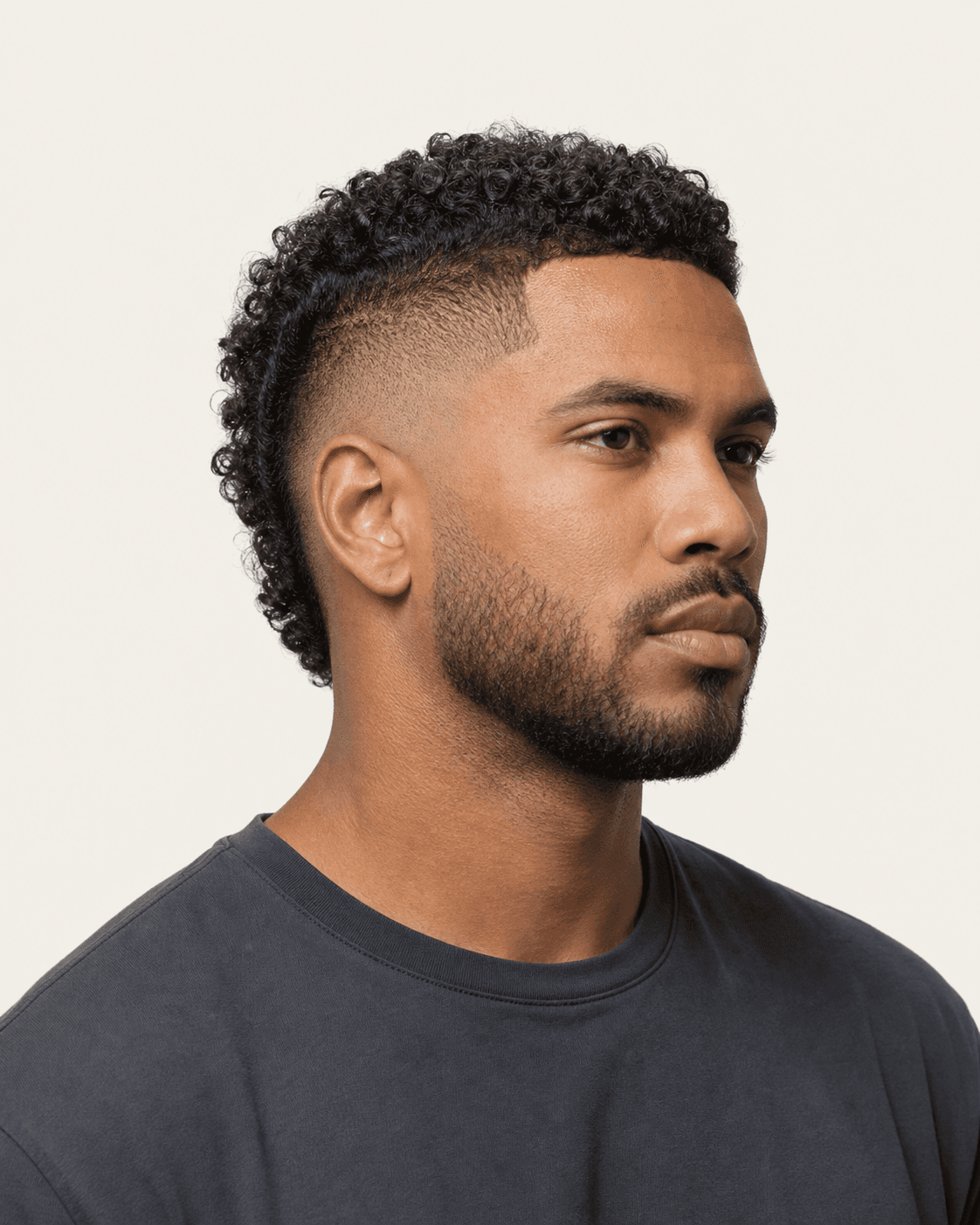
A narrow strip of defined natural curls running from the front through the crown to the upper nape, framed by curved burst-fade arcs around the ears and a softly tapered neckline.

Available as a mobile service at homes, offices, and hotels across Greater Montréal.

Three-quarter view of a burst fade with a curly mohawk
Interactive view4 verified angles

Three-quarter

20°

Drag to inspect the registered construction

Reference angle explorer

Drag or swipe · horizontal scroll or Shift + wheel · arrow keys

2 / 4

Fashion white · target #F2F0EA

Current documented coverage: four verified angles from 0° to 180°. A continuous 360° turntable publishes only after 24–36 consistent frames pass registry QA.

Showing three-quarter view at 20°.

Required registry views

One cut. Four viewpoints.

A single portrait can hide the taper, fade height, crown, weight line, or neckline. Every published Hairqut record must show the construction from the front, three-quarter, side, and rear. The recorded fashion white backdrop keeps the silhouette readable while preserving fine strand detail.

Front view of a curly mohawk with burst-faded sides
Front
Three-quarter view of a burst fade with a curly mohawk
Three-quarter20°
Side profile of a curly mohawk showing the curved burst fade around the ear
Side90°
Rear view of a curly mohawk showing a narrow retained strip and symmetric burst fades
Rear180°

Hairqut Style Blueprint · Style construction

A visual brief your professional can use.

The registered views establish the reference. This blueprint pins the most important construction decisions directly to those source views, then makes adaptation, maintenance, and the chair-side conversation clear.

Verified-angle construction map

Approved-view burst-fade mohawk map

The approved front, side, and rear registry views are annotated only where the natural front edge, narrow central curl strip, curved burst-fade arc, darker upper temple, retained rear strip, and soft nape taper are visible. The diagram does not invent guard numbers, exact fade height, clipper or shear sequence, curl-product formula, or continuous-subject proof.

3 publication views · 6 callouts

Annotated front construction map for Curly Burst-Fade Mohawk. Front view of a curly mohawk with burst-faded sides
Front
Approved publication view

Front edge and strip width

The front view establishes a natural hairline and the visible width of the retained central curl field.

01

Natural front edge

The front line stays close to the visible natural boundary without a painted or sharply pushed-back effect

02

Narrow central curl strip

Defined curls remain concentrated through the center; front depth alone does not prove rear continuity
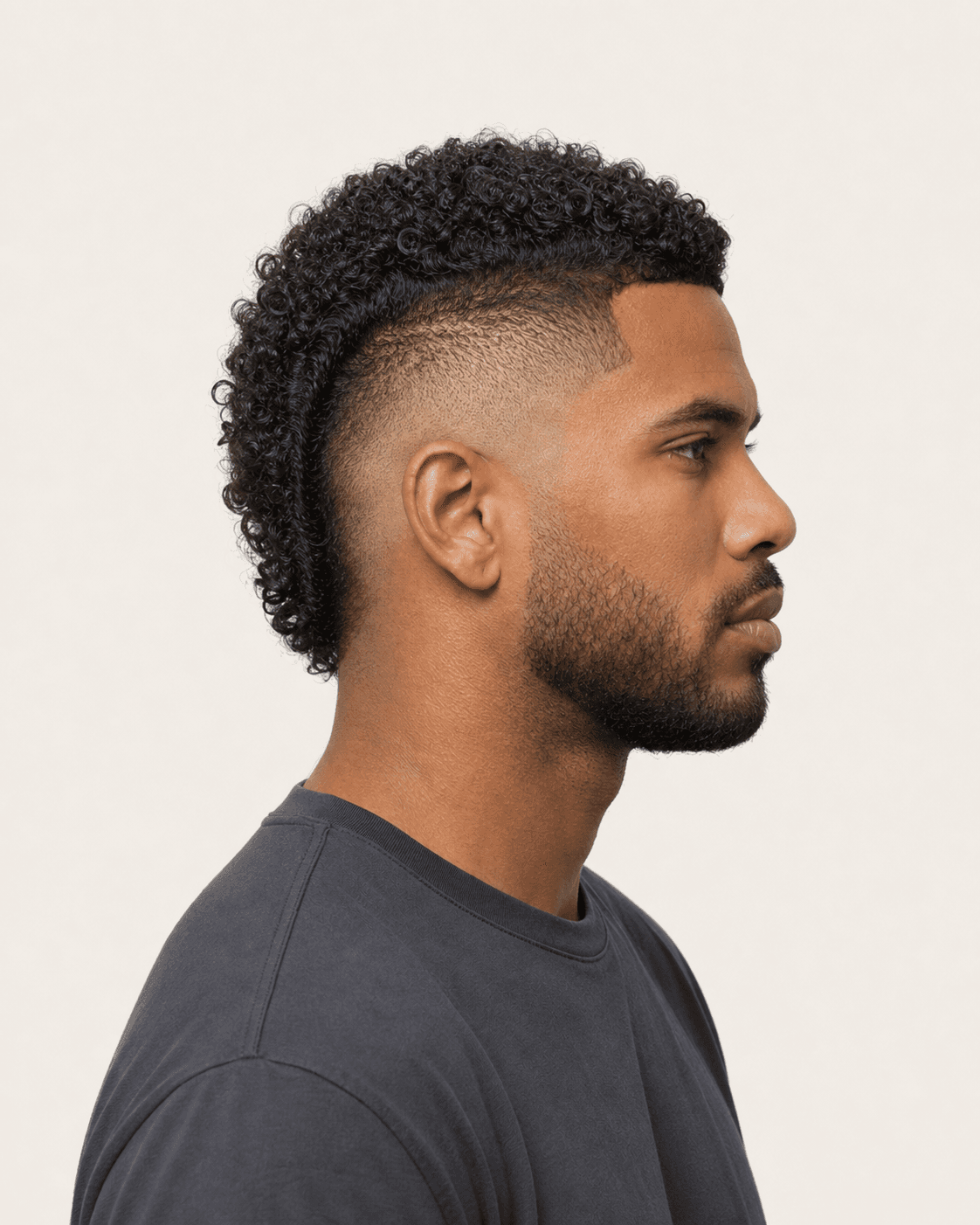
Annotated side construction map for Curly Burst-Fade Mohawk. Side profile of a curly mohawk showing the curved burst fade around the ear
Side90°
Approved publication view

Burst arc and retained temple

The profile exposes the curved fade route around the ear and the darker length that preserves the upper burst shape.

01

Curved burst-fade arc

The transition radiates around the ear instead of climbing as one level band across the full side

02

Darker upper temple

More visible weight remains above the burst transition to connect with the central curl field
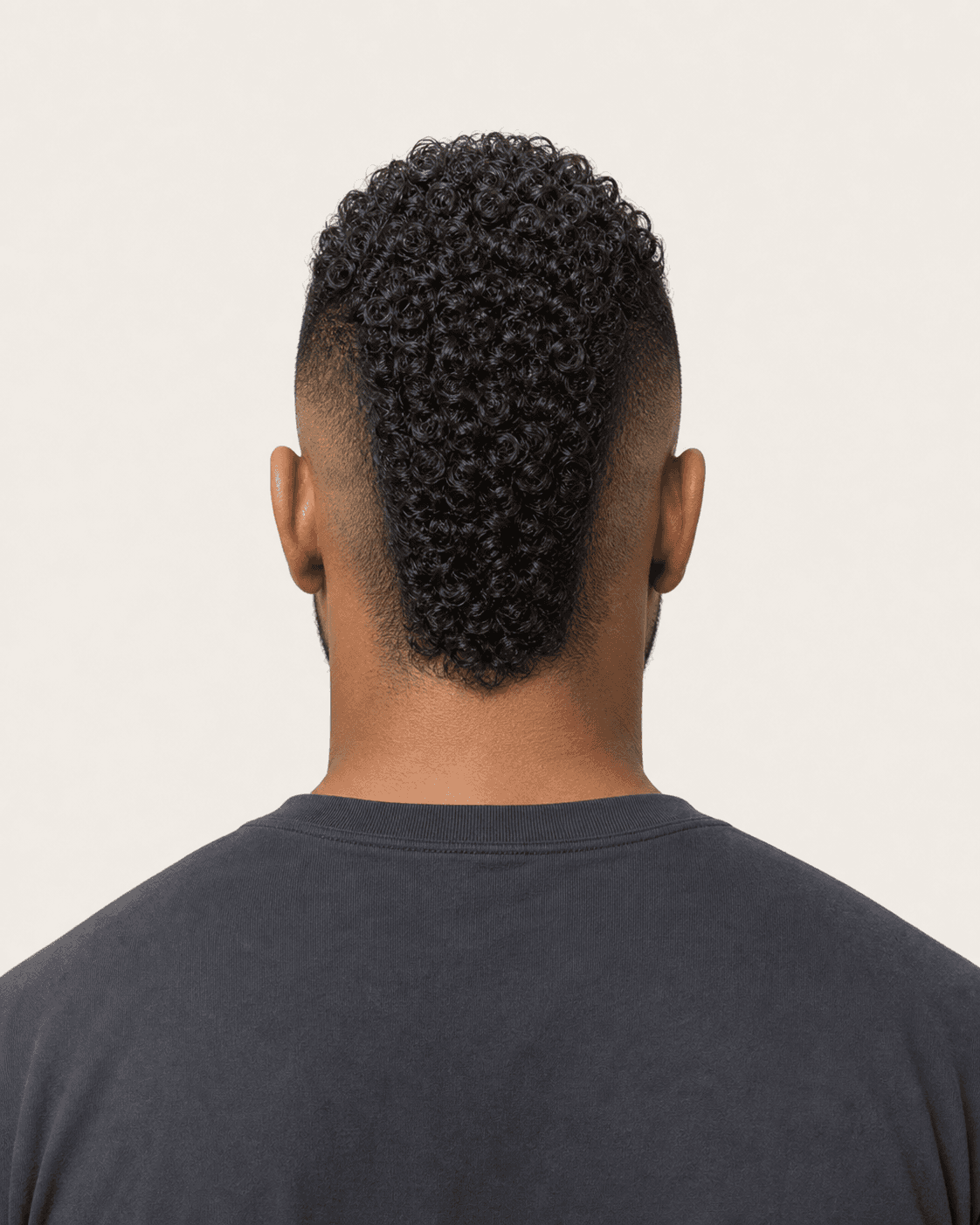
Annotated rear construction map for Curly Burst-Fade Mohawk. Rear view of a curly mohawk showing a narrow retained strip and symmetric burst fades
Rear180°
Approved publication view

Rear continuity and nape

The rear view confirms the dense curl strip through the occipital area and a soft transition at the lowest nape.

01

Retained rear strip

The central curl field continues through the crown and rear as a visibly denser narrow band

02

Soft nape taper

The lowest rear edge transitions softly without a blocked line or design

Pins locate the reference evidence; the numbered notes make the request legible in the chair. This is an original Hairqut communication diagram, not a universal service prescription.

Provenance: The diagram uses the locked approved publication views, which mirror the formal evidence package byte-for-byte. Its HTML and SVG overlays preserve those pixels and keep every label responsive and accessible. A newer generated raster was retained only as internal evaluation evidence because it recomposed the portraits, omitted one required label, and rasterized critical meaning.

Reference result

A narrow front-to-nape strip of defined curls, curved burst-fade arcs around the ears, retained upper-temple weight, and a softly tapered nape.

Starting-state gate

A professional must assess curl pattern, shrinkage, density, crown and nape growth, current fade placement, hairline history, scalp condition, and usable length before fixing the strip width or fade arc.

View interpretation

The front view can read as a curly top in isolation. The side and rear views establish the mohawk continuity; facial hair belongs to the fictional subject and is not part of the haircut specification.

Full specification · evidence graded

What is known, what must be assessed.

Every field is marked by its evidence boundary. “Unknown” is intentional: the registry never invents hidden technique, anatomy, timing, or price.

Construction

Technical specification

Central strip
A narrow, continuous band of defined curls runs from the front through the crown to the upper nape.
Recorded
Curl length
The registered result records approximately 4–6 cm of visible curl length; shrinkage and finish affect apparent height.
Recorded
Burst arc
The fade follows a curved route around each ear rather than one uniform horizontal band across the side.
Recorded
Temple weight
Darker length remains above the burst transition to preserve connection with the curl strip.
Visible
Rear continuity
The central strip stays visibly denser through the occipital area and upper nape.
Recorded
Front edge
The reference keeps a natural-looking front boundary without visible pigment or an aggressively pushed-back line.
Visible
Neckline
The lowest nape is softly tapered without a hard blocked finish or design line.
Recorded
Weight distribution
Density is retained through the central strip and upper temple while the ear area transitions lighter through the burst arc.
Visible
Guards and exact fade height
No clipper guard numbers, lever positions, measured fade height, or fixed arc coordinates are established by the approved evidence.
Unknown
Blend and cutting sequence
Clipper direction, blend order, shear or curl-shaping method, elevation, and internal curl-section handling are not visible in the finished result.
Unknown

Adaptation

Hair and suitability

Reference texture
The registry records a 3C–4A visual reference with defined natural curl clumps; this does not guarantee identical behavior for every pattern.
Recorded
Curl pattern and shrinkage
Assess wet-to-dry contraction, clump size, definition, and usable stretched length before setting visible height or strip width.
Assess
Density
Assess central, temple, crown, and nape density before narrowing the strip or removing side weight.
Assess
Porosity and finish response
Not recorded; assess absorption, dryness, buildup, chemical or colour history, and response to moisture and hold categories.
Assess
Growth direction
Crown whorls, nape direction, cowlicks, and side growth affect whether the rear strip can stay narrow and continuous.
Assess
Scalp and edge condition
Assess irritation, sensitivity, flaking, lesions, thinning, previous pushback, and tolerance before close fade or lineup work.
Assess
Face shape
No universal face-shape claim is supported; personalize strip width, curl height, temple weight, and burst placement to the person and goal.
Assess
Achievable starting state
The current top and rear must retain enough length and density for visible curl continuity; a high prior fade, short nape, sparse crown, or damaged curl field may require growth or a wider adaptation.
Assess
Finish dependence
Apparent curl height, clump definition, fade contrast, and strip width vary with moisture, product, shrinkage, lighting, growth, and styling state.
Recorded

Service handoff

Booking service
mens_haircut_afro
Appointment duration
Not specified in canonical evidence; confirm after current curl length, strip continuity, existing fade, desired arc, and any facial-hair request are assessed.
Price
Not stored in this style record; the current booking service controls price and any facial-hair or corrective work requires separate confirmation.

Professional requirements

Skills

  • Mapping a curved burst arc around the ear while preserving darker upper-temple weight
  • Maintaining a narrow curl strip through the crown and rear without removing unsupported density
  • Choosing clipper and blending steps from the current fade placement rather than a fixed guard recipe
  • Shaping defined curls and finishing a natural front edge and soft nape without unsupported enhancement

Tools and product categories

  • Professional clippers, trimmer, and guards selected after assessing the current length and fade placement
  • Shear or curl-shaping tools appropriate to the actual pattern, density, and target height
  • Light moisture and flexible hold categories chosen for porosity, scalp, and desired definition
  • Clean section-control, curl-refresh, and sanitation tools appropriate to the service plan

Safety and starting state

Confirm before service

  • Current curl pattern, clump size, stretched and finished length, shrinkage, density, and porosity
  • Existing fade height and shape, front edge, temple weight, crown direction, rear continuity, and nape growth
  • Scalp sensitivity, irritation, lesions, thinning, prior pushback, chemical or colour history, and product response
  • Requested strip width, curl height, burst arc, nape finish, maintenance preference, and any separate facial-hair work

Do not promise unchanged

  • Do not force a narrow strip where crown, rear, or nape density cannot support continuous visible curls.
  • Do not lift the burst arc into a high uniform fade or remove the darker upper-temple weight unless the person agrees to a different variation.
  • Do not push back the natural front edge, add pigment, carve a design line, or treat facial hair as part of the canonical haircut.
  • Do not perform close clipper or trimmer work over active irritation, lesions, unexplained bumps, or significant sensitivity without appropriate assessment.
  • Do not promise the registered 4–6 cm visible height or 3C–4A curl appearance from a materially different length, pattern, shrinkage, density, or damage state.

Evidence and governance

Source package: os/hairqut-styles/registry/entries/HQ-STYLE-000047-burst-fade-curly-mohawk

Asset relationship: All four approved publication images mirror the formal package byte-for-byte.

Generated media: The approved style views depict a fictional AI-generated subject; the underlying generation model and request ids are unavailable. The on-page diagram is a deterministic overlay on those locked views. A newer generated composite is retained only as internal evaluation evidence because it recomposed the portraits, omitted the darker-upper-temple label, and rasterized critical meaning.

Privacy: No real customer photo, identity, or biometric record is used in this Blueprint.

Booking handoff: The Blueprint links to the existing mens_haircut_afro service; duration, price, availability, corrective scope, and any facial-hair work come from the current booking and consultation flow.

Freshness

  • Asset quality and provenance package assessed 2026-08-01.
  • Blueprint geometry, internal image-generation evaluation, and full specification reviewed 2026-09-12.

Consultation

Confirm the strip, burst arc, and nape before cutting

  • Agree on the front-to-rear strip width, visible curl height, and how much rear continuity the current crown and nape can support.
  • Map the burst arc around each ear and confirm where darker upper-temple weight should remain.
  • Ask the professional to assess curl pattern, density, shrinkage, crown direction, scalp condition, existing fade placement, and prior edge history.
  • Confirm a natural front edge, soft nape taper, and whether facial-hair work is excluded or separately requested; it is not part of this style record.

Care plan

Keep the intent, not a fixed schedule.

  1. 1

    When the burst arc loses definition

    Refresh without lifting the fade

    Re-establish the curved ear arc and soft nape only after checking the current blend; the recorded 2–4 week range is typical guidance, not a universal schedule.

  2. 2

    When strip width or curl height changes

    Rebalance the full shape

    Review the central strip, crown connection, rear density, and curl height together; the recorded 4–6 week range varies with growth and finish preference.

  3. 3

    On styling days

    Preserve curl definition

    Use a small amount of an assessed moisture or hold category and avoid brushing the retained strip into an undefined mass.

  4. 4

    If scalp or edge symptoms appear

    Pause close work

    Tenderness, irritation, lesions, or inflamed areas need assessment before further close clipper, trimmer, or product contact.

Home kit

Product categories, not product pressure.

Cleanse

Gentle scalp and curl cleanser category

Choose frequency and formula for the current scalp, porosity, buildup, and styling routine.

Moisture

Light curl-moisture category

Use only enough to support definition without coating the strip or irritating freshly faded areas.

Hold

Flexible curl-definition category

Select strength for the current pattern and desired finish rather than assuming one formula fits every 3C–4A appearance.

Shape

Low-friction curl refresh method

Re-form visible curl clumps gently without pulling across the fade, front edge, or nape.

These are care and tool categories, not paid placements or a substitute for professional curl, scalp, growth-pattern, and edge assessment. No brand claim, fixed refresh interval, guard prescription, or guaranteed curl response is present.

Professional brief

Hand this evidence-bound burst-fade brief to your professional

Use the four approved registry views to align on the visible strip, burst arc, temple weight, curls, and nape, then let the professional adapt guard choice, blend sequence, and proportions to the current hair and growth pattern.

  • The four approved registry views and the warning that the front alone compresses strip depth
  • A narrow curl strip continuing from the front through the crown to the upper nape
  • Curved burst arcs around the ears with retained darker upper-temple weight
  • Approximately 4–6 cm of visible curl length where the current pattern and density support it
  • A natural front edge, soft nape taper, and no design line or unsupported enhancement
Book with this Blueprint

Blueprint v1.2 · reviewed . Every diagram pin and technical field was checked against the approved front, side, or rear publication view, the locked canonical record, and the formal evidence package. Exact guards, measured fade height, clipper or shear sequence, elevation, natural curl response, porosity, timing, price, and continuity across AI-derived views were left unknown or assessment-required rather than inferred.

Canonical reference data

The source record behind the Blueprint.

These are the canonical attributes of the illustrated record. The Blueprint above translates them for a consultation; this section keeps the technical source explicit.

Curl length
Approx. 4–6 cm
Reference texture
3C–4A
Sides
Curved burst fade
Rear
Retained curly strip

Cut construction

Central strip
A continuous narrow band of curls runs from the front through the crown to the upper nape.
Burst arc
The fade radiates in a curved path around each ear rather than climbing uniformly across the whole side.
Temples
Darker length remains near the upper temple to preserve the burst shape.
Rear
The curly strip stays visibly denser through the occipital area and upper nape.
Neckline
The lowest nape is softly tapered without a hard blocked line or design.

Quality assessment

Visible, not implied.

93/ 100

Publication threshold: 85. Assessed .

Identity consistency92
Haircut geometry93
View compliance100
Hair realism94
Anatomy realism94
Photography consistency93
Provenance completeness95
Why this record passed with warnings
  • The front view compresses the depth of the central strip and can read as a curly top in isolation; the side and rear views confirm the continuous narrow mohawk geometry.
  • Facial hair is part of the fictional subject identity but is not a defining attribute of the registered haircut.
  • OpenAI built-in image generation was used; the underlying model identifier is not exposed by this surface.
  • AI-derived viewpoints are internally consistent illustrations, not proof that one physical subject was photographed continuously from four angles.

Registry provenance

100% AI-generated from scratch.

The four images are an intentionally matched fictional reference set made specifically for this Hairqut record. Fictional person; no real person or celebrity was used as a reference. The set passed deterministic asset checks and a separate visual consistency assessment.

Generated media record: OpenAI built-in image generation via ChatGPT. underlying model identifier not exposed.

Book your appointment