
Hairqut.
HQ-STYLE-000006QA passed with warnings

Haircut · Bob

Blunt Chin-Length Bob with Center Part

A center-parted blunt bob with a compact straight reference finish, chin-adjacent front corners, covered ears, dense lower weight, and a broadly level rear edge.

Available as a mobile service at homes, offices, and hotels across Greater Montréal.

Three-quarter view of a blunt chin-length bob showing a dense lower edge and smooth side panel
Interactive view4 verified angles

Three-quarter

20°

Drag to inspect the registered construction

Reference angle explorer

Drag or swipe · horizontal scroll or Shift + wheel · arrow keys

2 / 4

Fashion white · target #F2F0EA

Current documented coverage: four verified angles from 0° to 180°. A continuous 360° turntable publishes only after 24–36 consistent frames pass registry QA.

Showing three-quarter view at 20°.

Required registry views

One cut. Four viewpoints.

A single portrait can hide the taper, fade height, crown, weight line, or neckline. Every published Hairqut record must show the construction from the front, three-quarter, side, and rear. The recorded fashion white backdrop keeps the silhouette readable while preserving fine strand detail.

Front view of a blue-black blunt chin-length bob with a center part
Front
Three-quarter view of a blunt chin-length bob showing a dense lower edge and smooth side panel
Three-quarter20°
Side profile of a blunt chin-length bob showing level baseline and minimal bevel
Side90°
Rear view of a blue-black blunt bob showing center part and level upper-nape baseline
Rear180°

Hairqut Style Blueprint · Style construction

A visual brief your professional can use.

The registered views establish the reference. This blueprint pins the most important construction decisions directly to those source views, then makes adaptation, maintenance, and the chair-side conversation clear.

Verified-angle construction map

Approved-view blunt chin bob construction map

The approved front, side, and rear registry views are annotated only where the center part, chin-adjacent front corners, covered ear, compact straight side fall, continued rear part, and broadly level rear edge are visible. The diagram does not prescribe texture code, exact length, true one-length construction, hidden layers, elevation, graduation, overdirection, cutting angle, tension, heat setting, product formula, or timing.

3 publication views · 6 callouts

Annotated front construction map for Blunt Chin-Length Bob. Front view of a blue-black blunt chin-length bob with a center part
Front
Approved publication view

Center part and chin-adjacent front corners

The front establishes the visible part and broadly balanced corners around the chin.

01

Center part

A visible central part divides the smooth front fall; exact section width, natural persistence, and hidden direction are not recorded

02

Chin-adjacent front corners

The visible front corners end around the chin and appear broadly balanced; exact centimetres and dry response are not measured

Annotated side construction map for Blunt Chin-Length Bob. Side profile of a blunt chin-length bob showing level baseline and minimal bevel
Side90°
Approved publication view

Covered ear and compact straight side fall

The profile shows a smooth compact side panel concealing the ear and ending near the chin.

01

Covered ear

The side panel fully obscures the ear in the approved profile; comfort, density, and natural tuck behavior require assessment

02

Compact straight side fall

The visible surface falls smoothly into a dense lower edge with a restrained inward turn; heat method and natural texture are not established
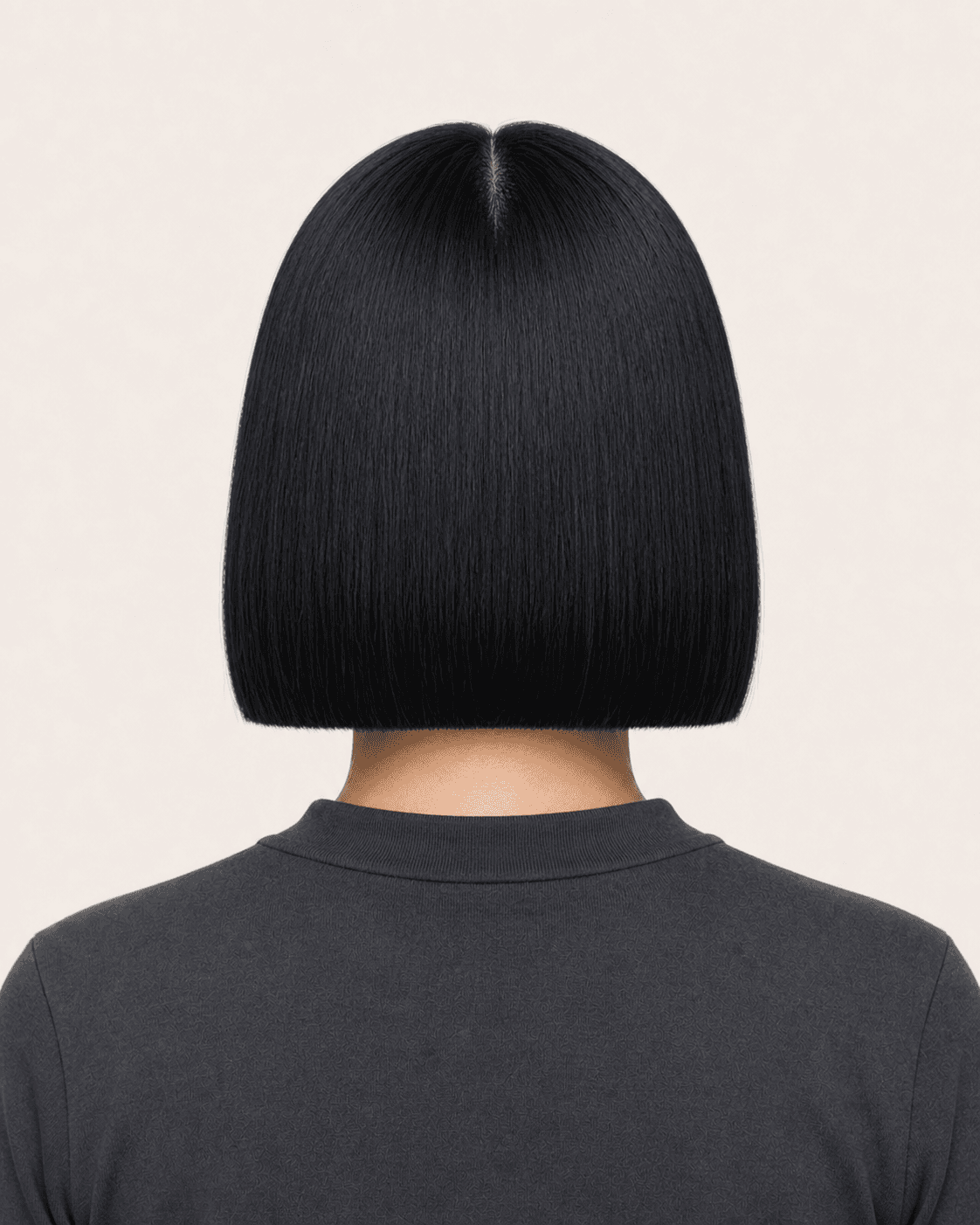
Annotated rear construction map for Blunt Chin-Length Bob. Rear view of a blue-black blunt bob showing center part and level upper-nape baseline
Rear180°
Approved publication view

Continued center part and broadly level rear edge

The rear records the part through the upper crown and a dense blunt-looking edge above the low nape.

01

Continued center part

The center line remains visible through the upper rear crown; sectioning, crown growth, and natural reset behavior are not stored

02

Broadly level rear edge

The dense lower edge reads broadly level above the low nape without proving zero graduation, one-length construction, or measured symmetry

Pins locate the reference evidence; the numbered notes make the request legible in the chair. This is an original Hairqut communication diagram, not a universal service prescription.

Provenance: The diagram uses locked approved publication views that mirror the reconciled formal package byte-for-byte. Semantic HTML and SVG overlays preserve those pixels. A newer generated raster passed all six exact labels but remains internal because it re-renders the subject and rasterizes critical meaning.

Reference result

A center-parted blunt bob with a compact straight finish, chin-adjacent front corners, covered ears, dense lower weight, and a broadly level rear edge.

Starting-state gate

A professional must assess natural texture, dry and wet length, shrinkage or expansion, density, strand diameter, growth direction, part behavior, condition, porosity, scalp, prior layers, and routine before confirming the result.

Personal adaptation

Part position, fringe preference, ear coverage, chin relationship, neck contact, lower weight, natural movement, smoothing tolerance, and maintenance preference matter more than copying the image. The straight finish is not a universal texture rule.

Full specification · evidence graded

What is known, what must be assessed.

Every field is marked by its evidence boundary. “Unknown” is intentional: the registry never invents hidden technique, anatomy, timing, or price.

Construction

Technical specification

Taxonomy and naming
The canonical record identifies a blunt chin-length bob with center part: a compact bob-family haircut defined by its dense lower edge and chin-adjacent front corners.
Recorded
Front geometry
A center part divides a smooth, broadly balanced fall into chin-adjacent front corners with covered ears.
Visible
Top and crown
The crown reads smooth and compact without visible short disconnection, stacked height, or exposed layer separation; hidden support is not recorded.
Visible
Side panel
The side falls smoothly over the ear into a dense lower edge near the chin with a restrained inward turn.
Visible
Rear geometry
The rear shows compact straight fall, a continued central part, dense lower weight, and a broadly level edge above the low nape.
Visible
Perimeter position
Front corners sit around the chin and the rear edge sits above the low nape; exact centimetres, dry-versus-wet change, and measured level are not recorded.
Visible
Parting and direction
A central part is visible from front through upper rear crown with the surface directed down into the sides and rear; natural persistence requires assessment.
Visible
Weight line
The visible lower edge carries dense weight and reads blunt, but finished pixels do not prove a true one-length structure or zero hidden graduation.
Visible
Texture classification
A compact straight reference finish is visible. An exact 1B classification and the natural unstyled pattern cannot be reliably assigned from the images alone.
Visible
Hidden construction
Sectioning, elevation, overdirection, graduation, internal layers, cutting angle, tension, wet-to-dry allowance, tool path, and smoothing method are not stored or safely inferable.
Unknown
Variation boundary
An off-center part, fringe, exposed ears, severe A-line, stacked nape, disconnected undercut, rounded layered perimeter, shoulder-length lob, or strongly curled-under set is a variation rather than this exact reference.
Recorded

Adaptation

Hair and suitability

Reference texture
The approved result shows a smooth compact straight finish. This is a visible reference state, not proof of natural texture or a universal suitability restriction.
Visible
Texture and movement
Assess straight, wavy, curly, or coily behavior, shrinkage, expansion, bend, frizz, humidity response, and finish expectations before setting the perimeter.
Assess
Density and strand support
Assess density and strand diameter through temples, sides, crown, rear, and nape. Lower density, finer strands, or prior thinning may need retained weight or a softer edge treatment.
Assess
Growth and part behavior
Assess front hairline, natural part, crown split, cowlicks, side direction, ear-area growth, and nape pattern before confirming centered balance and edge placement.
Assess
Length and achievable edge
Assess dry and wet length by zone. Short front pieces, uneven sides, high nape, existing layers, breakage, or severe asymmetry may require adaptation or growth.
Assess
Condition and porosity
Assess dryness, absorption, buildup, tangling, breakage, elasticity, colour or chemical history, and heat response before detangling, cutting, or smoothing.
Assess
Scalp and sensitivity
Assess tenderness, irritation, lesions, flaking, thinning, ingredient sensitivity, brushing tolerance, and heat comfort before service.
Assess
Face and head shape
No universal face-shape rule is supported. Personalize part position, front-corner length, ear coverage, side fullness, crown volume, rear edge, and inward turn while retaining the blunt-bob identity.
Assess
Routine and environment
Confirm washing, detangling, drying, heat use, neck contact, humidity, activity, sleep routine, time, budget, and maintenance preference before promising manageability.
Assess
Continuous-view limitation
The four AI-derived views are internally consistent illustrations but do not prove one continuous physical subject, identical strand placement, or a hidden one-to-one section map.
Unknown

Service handoff

Booking service
womens_haircut
Appointment duration
Not specified in canonical evidence; confirm after dry and wet length, texture, movement, density, tangling, current layers, condition, scalp, drying, and finish expectations are assessed.
Price
Not stored in this style record; the current booking service controls price and any correction, treatment, extensive detangling, heat styling, or additional finish requires separate confirmation.

Professional requirements

Skills

  • Assessing dry and wet perimeter position with texture movement, part behavior, and current layers considered
  • Balancing chin-adjacent front corners, covered ears, dense lower weight, and a broadly level rear edge
  • Choosing hidden elevation, graduation, or internal weight control from actual density and fall rather than assuming one length
  • Detangling, cutting, drying, and smoothing with scalp, condition, porosity, heat tolerance, and client routine protected

Tools and product categories

  • Professional shears, combs, clips, and sectioning tools selected from the assessed plan rather than a fixed recipe
  • Detangling brush, wide-tooth comb, or other suitable tool selected for current texture, tangling, density, and comfort
  • Controlled dryer and smoothing tool only when wanted and appropriate, with temperature and tension selected for current condition
  • Cleansing, conditioning, detangling, heat-protection, and light finish categories selected for current hair, scalp, sensitivity, climate, and routine

Safety and starting state

Confirm before service

  • Current dry and wet front, side, rear, and nape lengths plus uneven growth, prior home trimming, or asymmetry
  • Natural texture, shrinkage or expansion, density, strand diameter, part and crown behavior, tangling, and daily fall
  • Existing layers, graduation, undercut, chemical or heat history, breakage, scalp condition, and product buildup
  • Preferred chin relationship, ear and neck contact, part location, lower weight, finish, heat use, time, budget, and maintenance cadence

Do not promise unchanged

  • Do not promise a true one-length or zero-graduation construction from the finished images alone.
  • Do not assign an exact 1B texture code or promise the compact straight finish without assessing natural movement and desired heat use.
  • Do not remove perimeter length before confirming dry response, part behavior, current layers, nape height, and front-corner position.
  • Do not promise exact chin alignment, identical symmetry, low maintenance, or a fixed 6–8 week interval across clients.
  • Do not use excessive heat, tension, forceful detangling, or irritating product on fragile hair or a tender or compromised scalp.

Evidence and governance

Source package: os/hairqut-styles/registry/entries/HQ-STYLE-000006-blunt-chin-length-bob

Asset relationship: All four approved publication images mirror the formal package byte-for-byte.

Generated media: The approved style views depict a fictional AI-generated adult; the underlying generation model and request ids were not recorded. The on-page diagram is a deterministic overlay on those locked views.

Privacy: No real customer photo, identity, or biometric record is used in this Blueprint.

Booking handoff: The Blueprint links to the existing womens_haircut service; duration, price, and availability come from the current booking flow.

Freshness

  • Asset quality and source-record provenance assessed 2026-07-19 and formally reconciled 2026-09-12.
  • Blueprint geometry and full specification reviewed 2026-09-12.

Consultation

Confirm the dry perimeter, part behavior, and lower weight

  • Agree on the dry front-corner position, side and rear edge, ear coverage, part location, lower weight, and amount of inward turn using the approved views.
  • Assess natural texture, shrinkage or expansion, density, strand diameter, part and crown growth, nape direction, condition, porosity, scalp, and current layers before choosing construction.
  • Confirm whether current length and prior layers can support a dense blunt-looking edge now or whether an adapted shape or growth plan is needed.
  • Confirm drying, heat, tension, product feel, humidity response, neck contact, time, budget, and maintenance preferences without prescribing a fixed method.

Care plan

Keep the intent, not a fixed schedule.

  1. 1

    When the lower edge loses balance

    Reassess the dry perimeter before trimming

    The source mentioned 6–8 weeks, but growth, texture, shrinkage, density, current shape, routine, condition, and budget determine actual timing.

  2. 2

    After washing

    Choose the finish the current hair can support

    Air-dry or use controlled drying and heat only as assessed. A compact straight reference finish does not prove that daily smoothing is appropriate or required.

  3. 3

    As the part shifts

    Review natural balance before forcing the center line

    Cowlicks, crown split, density, growth direction, and preferred fall may change apparent corner and perimeter balance.

  4. 4

    Between services

    Protect the dense edge from avoidable damage

    Adapt heat, tension, brushing, sleep friction, and product buildup if dryness, breakage, scalp discomfort, stiffness, or loss of movement increases.

Home kit

Product categories, not product pressure.

Cleanse

Gentle scalp and hair cleansing category

Choose strength and frequency for scalp, buildup, activity, texture, porosity, colour history, and routine.

Condition

Conditioning and detangling category

Choose slip and weight for density, strand diameter, porosity, tangling, ingredient response, and desired movement.

Dry and protect

Air-dry or controlled dryer plus heat-protection category

Select airflow, temperature, tension, tool contact, and protectant for condition, natural texture, scalp comfort, and heat tolerance.

Finish

Light smoothing or anti-humidity category

Select hold, weight, scent, buildup, washability, and climate response through testing; the approved image does not establish a formula.

These are care and tool categories, not paid placements or a substitute for professional assessment. No exact 1B texture, true one-length structure, hidden layer map, elevation, graduation, overdirection, cutting angle, tension, measured chin line, heat setting, product formula, appointment duration, price, maintenance interval, or universal suitability is prescribed.

Professional brief

Hand this evidence-bound blunt chin bob brief to your professional

Use the four approved views to align on the center part, chin-adjacent corners, covered ears, compact straight side fall, dense lower weight, and broadly level rear edge, then choose hidden construction and finish from the current hair.

  • The four approved views and the warning that they are AI-derived illustrations rather than one continuous physical capture
  • A visible center part with natural persistence and preferred balance assessed rather than forced from the image
  • Chin-adjacent front corners and covered ears with neck and face contact confirmed for comfort
  • A dense blunt-looking side and rear edge without claiming true one-length or zero graduation from surface pixels
  • A drying, heat, product, and maintenance plan selected for current texture, density, porosity, condition, climate, time, and budget
Book with this Blueprint

Blueprint v1.2 · reviewed . Every diagram pin and technical field was checked against the approved front, side, or rear publication view, the canonical record, and the formal evidence package. Exact texture code, length, true one-length status, hidden layering, sectioning, elevation, graduation, overdirection, cutting line, tension, porosity, face-shape suitability, heat setting, product formula, maintenance timing, appointment duration, price, continuity, and unrecorded generation details were left unknown or assessment-required rather than inferred.

Canonical reference data

The source record behind the Blueprint.

These are the canonical attributes of the illustrated record. The Blueprint above translates them for a consultation; this section keeps the technical source explicit.

Finished length
Point of chin
Reference texture
Dense straight reference finish
Geometry
Dense blunt-looking lower edge
Finish
Minimal inward bevel

Cut construction

Parting
A visible center part establishes the reference balance; its natural persistence requires assessment.
Elevation
The finished surface falls compactly with no visible layer separation, stack, or graduated nape; hidden elevation and graduation are not recorded.
Front corners
Both visible corners sit around the chin and connect into the dense side edge; exact alignment is not measured.
Baseline
A dense blunt-looking edge remains broadly level through the side and rear viewpoints.
Finish
The ends show a restrained inward turn rather than a strongly rounded layered shape; the affected length is not measured.
Reference colour
Blue-black; colour is not a defining feature of the cut.

Quality assessment

Visible, not implied.

94/ 100

Publication threshold: 85. Assessed .

Identity consistency94
Haircut geometry96
View compliance99
Hair realism94
Anatomy realism95
Photography consistency85
Provenance completeness95
Why this record passed with warnings
  • Studio exposure varies modestly across viewpoints, while the dark blunt silhouette and baseline remain clearly legible.
  • AI-derived viewpoints are internally consistent illustrations, not proof that one physical 3D subject was photographed from four angles.

Registry provenance

100% AI-generated from scratch.

The four images are an intentionally matched fictional reference set made specifically for this Hairqut record. Fictional person; no real person or celebrity was used as a reference. The set passed deterministic asset checks and a separate visual consistency assessment.

Generated media record: OpenAI built-in image generation via ChatGPT. Not recorded in the canonical source record.

Book your appointment